
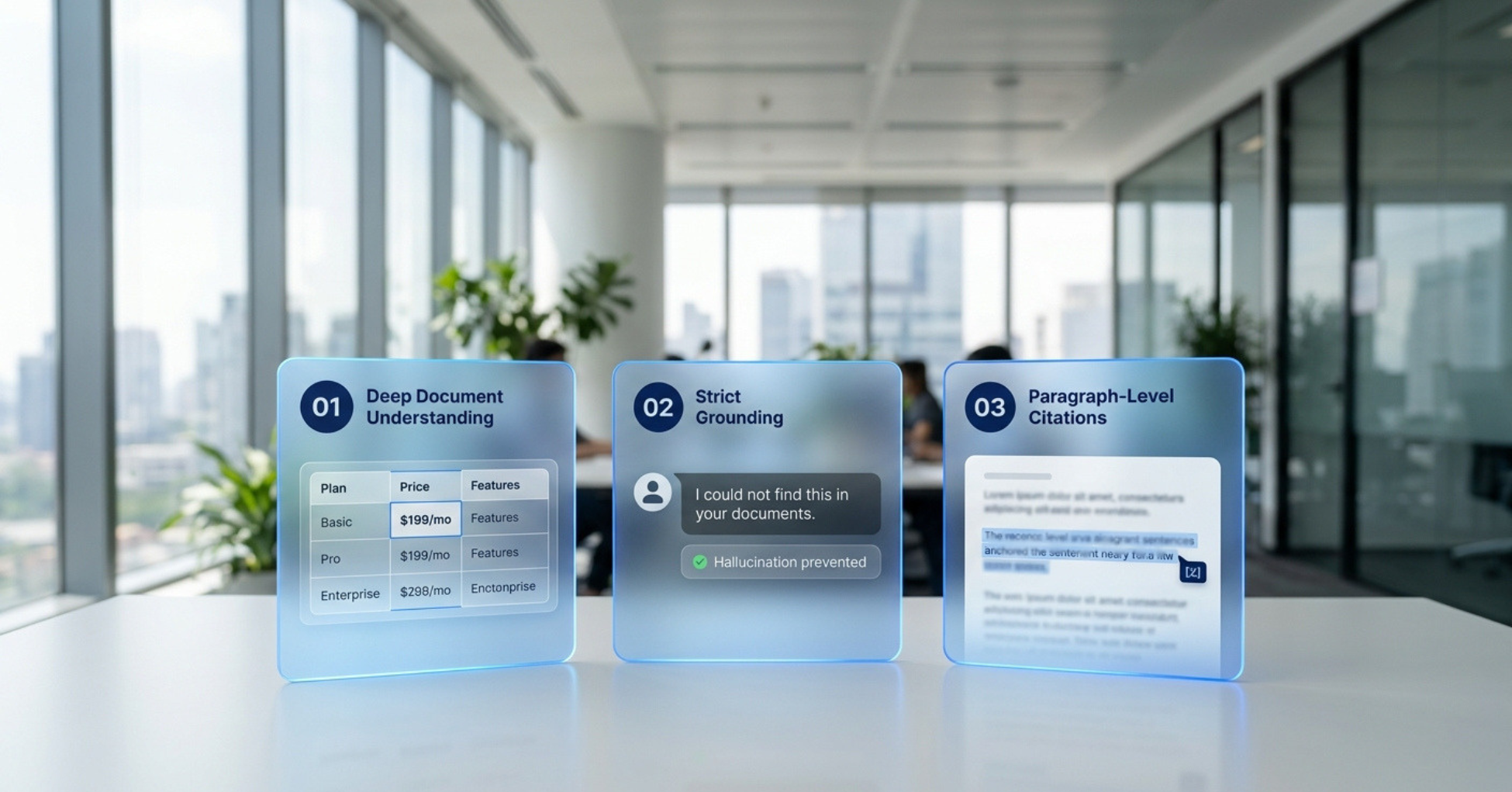
The lowest hallucination rates in enterprise AI search are achieved through three distinct architectural choices: deep document understanding that preserves complex formatting, strict grounding that prevents the model from guessing, and mandatory citations that link every answer directly to its source. Evaluating vendors against these three criteria and testing them using your own complex documents before signing, is the only reliable way to find an AI platform your compliance and legal teams can trust.
A sales rep is finalizing a major contract and asks for their internal AI search tool for the standard volume discount on a specific hardware unit. The AI instantly returns a confident answer: “15%.” The rep quotes the prospect; the deal is signed, and the company absorbs a massive margin of loss.
Why did this happen? The AI pulled that figure from an outdated PDF. The updated pricing table placed that specific product in a nested column with a strict 5% maximum discount, but the AI’s document parser couldn’t read the nested table structure. It grabbed the wrong number, cited no verifiable source, and the rep blindly trusted it.
When an AI hallucinates in a consumer app, it is a joke on social media. When it hallucinates in an enterprise environment, it is an acute financial liability. In finance, a hallucinated contract clause triggers a client dispute. In telecom, a fabricated SLA penalty damages a vendor relationship. In manufacturing, a hallucinated engineering specification causes a catastrophic compliance failure.
Enterprises have moved past the initial excitement of generative AI speed and are now dealing with the hard cost of unverified accuracy. Hallucination control is no longer a technical footnote. For regulated industries, it is the primary buying criterion.
Why Do AI Search Tools Hallucinate on Private Enterprise Data?
Vendor marketing loves to blame hallucinations on the LLM layer, pointing to model size, training data, or temperature settings as the culprits. But when an AI gives a wrong answer based on your proprietary data, the failure usually stems from two architectural flaws that happen before the model even generates a word.
1. Standard LLMs Sound Confident, Not Uncertain
Large Language Models are probabilistic engines trained on vast amounts of public data to predict the next most logical word in a sequence. By design, if they cannot find the answer to your private documents, they fill the gaps with their public training knowledge. They do not naturally say, “I don’t have enough information.”
The AI does not know what it does not know. It answers with the exact same confident tone whether it has retrieved the correct internal policy document or is generating a plausible lie based on its foundational training weights. The fix for these lives in the platform architecture, specifically through strict grounding configurations, not in paying for a “smarter” LLM.
(Read more: Why Revenue Teams Are Drowning in Tools But Starving for Revenue AI Signals)
2. The Document Formatting Failure Nobody Talks About
Here is the reality of enterprise AI that most vendors avoid discussing: the vast majority of search tools process enterprise documents by entirely stripping their formatting. They extract raw text and discard the structural relationships that give that text its meaning.
Take a 50-page contract PDF filled with nested pricing tables, multi-column layouts, and cross-referenced clauses. When a standard AI tool ingests it, that document becomes a flat, garbled stream of disconnected text. A critical clause that reads Rate: $4.20 / unit (Column 3, Row 7, Table 4.2, Schedule B) becomes 4.20 unit floating in complete isolation.
The LLM then attempts to answer a question about that clause from a text stream that has lost all its relational context. It gets the answer wrong. Not because the LLM is bad, but because the document parsing failed at the ingestion layer. If your parser loses table context, the hallucination is baked in. No subsequent LLM upgrade can recover that lost accuracy.
The 3 Criteria for Evaluating Hallucination Control
To avoid the formatting collapse and stop models from guessing, buyers need an objective framework. Use these three criteria to evaluate any enterprise AI vendor.
Criterion 1 — Deep Document Understanding
The question to ask: “How does your platform process a 50-page PDF with nested pricing tables and multi-column layouts? Show me the ingested document structure, not just the text output.”
What to look for: You need table structure preservation where row and column relationships are maintained. Multi-column text must be read in the correct sequence. Captions and cross-references must remain linked to their original figures.
What to reject: Platforms that demo exclusively with clean, single-column Word documents or simple FAQ formats. Those do not represent real enterprise complexity.
Criterion 2 — Strict Grounding: The ‘I Don’t Know’ Test
The question to ask: “Can your platform be configured to return No document found rather than generating a best-guess answer?”
What to look for: A configurable strict-grounding mode where the AI outright refuses to answer using external training data when your private document set lacks a clear answer.
The test: Ask the AI for a question where the answer is definitively not in your document set. A platform with strict grounding returns, “I could not find this information in your documents.” A platform without it generates a plausible-sounding lie. In a regulated environment, a confident wrong answer is infinitely more dangerous than an honest “I don’t know.”
Criterion 3 — Verifiable Citations at the Paragraph Level
The question to ask: “Does your citation link to the general document, or to the specific paragraph, table row, or section within the document?”
A document-level citation tells an employee which 100-page file the answer came from. That still requires them to manually hunt for information. A paragraph-level citation links directly to the specific passage or table of cell. The employee clicks through and verifies the source in seconds.
This is a hallucination control mechanism, not a UX feature. When the AI is architecturally forced to cite a specific source, it cannot fabricate an answer it has no source for.
The Human-in-the-Loop Imperative
The correct role of enterprise AI search is to compress 50 pages of manual reading time into 5 seconds of retrieval. The human then verifies the citation and makes the decision. The AI should find the needle, not pull the trigger.
This verification step is the correct architecture for high-stakes decisions. An employee asked, “What is our SLA penalty for this client?” receives the AI’s answer alongside a direct link to the exact clause in the Master Services Agreement. The employee reads the clause, confirms the figure, and responds to the client. The speed benefit is delivered; the liability risk is eliminated.
Without a verifiable citation, there is no audit trail. If a compliance officer relies on an AI-generated answer about a regulatory reporting deadline and the AI is wrong, the officer cannot demonstrate what information they relied on to make that call. Having a clear audit trail for AI-assisted decisions is rapidly becoming a strict regulatory requirement in multiple jurisdictions.
How to Run a Hallucination Benchmark Before Signing
Do not take a vendor word for their accuracy rates. Run this benchmark to cut through demo theater.
1. Use Your Own Documents
Every vendor will demo using files their platform handles flawlessly. Supply them with your messiest, most complex files: at least one dense PDF with nested legal schedules, one scanned contract with poor OCR quality, and one highly technical document with multi-column layouts.
2. Design Three Specific Tests
The Accuracy Test: Ask a question where the correct answer requires reading a specific clause or table cell.
The Parsing Test: Ask a question that requires correctly reading a nested table or cross-referenced clause. This proves whether their ingestion engine preserved structural context.
The Strict Grounding Test: Ask a question where the answer is definitively not in any of the documents. Does the platform confess ignorance, or does it hallucinate a lie?
3. Watch for Red Flags
Walk away if the vendor points to internal accuracy stats rather than independent benchmarks, gives a vague answer when asked exactly how they parse nested tables, or provides citations that only link to a broad folder.
Why fifthelement.ai Achieves Industry-Leading Accuracy
fifthelement.ai was purpose-built for complex, regulated industries, telecom, finance, manufacturing, where hallucination control is a foundational requirement, not a roadmap feature.
The formatting failure that causes most enterprise AI hallucinations is solved natively at our ingestion layer. The platform preserves table structure, column relationships, figure captions, and cross-references when processing complex documents. The LLM receives structured, context-intact data, completely avoiding the flat-text parsing collapse.
Coupled with strict grounding, the platform returns “No document found” rather than generating best-guess answers. Every output features mandatory paragraph-level citations, linking you directly to the exact SharePoint file or CRM record. Finally, through RBAC-governed retrieval, citations are only surfaced from documents the querying user is explicitly authorized to access.
If you are looking to deploy enterprise AI agents, accuracy and governance cannot be an afterthought. They must be the architecture.
Frequently Asked Questions
What causes AI hallucinations in enterprise search?
Most enterprise AI hallucinations are caused by document parsing failures. When AI tools strip complex formatting (like nested tables and columns) into flat text, the LLM loses the structural context required to answer accurately. The secondary cause is a lack of strict grounding, allowing the LLM to guess using public training data.
What is strict grounding in enterprise AI and why does it matter?
Strict grounding is a configuration that forces the AI to answer exclusively from the provided private data. If the answer is not in the documents, strict grounding forces the AI to reply, “I don’t know,” preventing it from fabricating plausible sounding lies.
How do I test an enterprise AI platform’s hallucination rate before buying?
Provide the vendor with your most complex, poorly formatted documents (e.g., nested pricing PDFs). Ask questions that require reading specific table cells and ask a question where the answer does not exist in the text to see if the AI will hallucinate or admit it lacks the information.
What is the difference between a document-level citation and a paragraph-level citation?
A document-level citation only tells you which file an answer came from, forcing you to manually hunt through dozens of pages to verify it. A paragraph-level citation links directly to the exact sentence, table of cell, or clause of the AI used, allowing for verification in seconds.
How does fifthelement.ai minimize hallucinations in enterprise AI search? fifthelement.ai uses deep document understanding to preserve complex table and column structures during ingestion. It pairs this with strict grounding to prevent model guessing and enforces mandatory paragraph-level citations for every output.
Experience “Answers you can trust.” See how fifthelement.ai delivers high-accuracy, citation-backed enterprise search for complex, regulated environments.

