
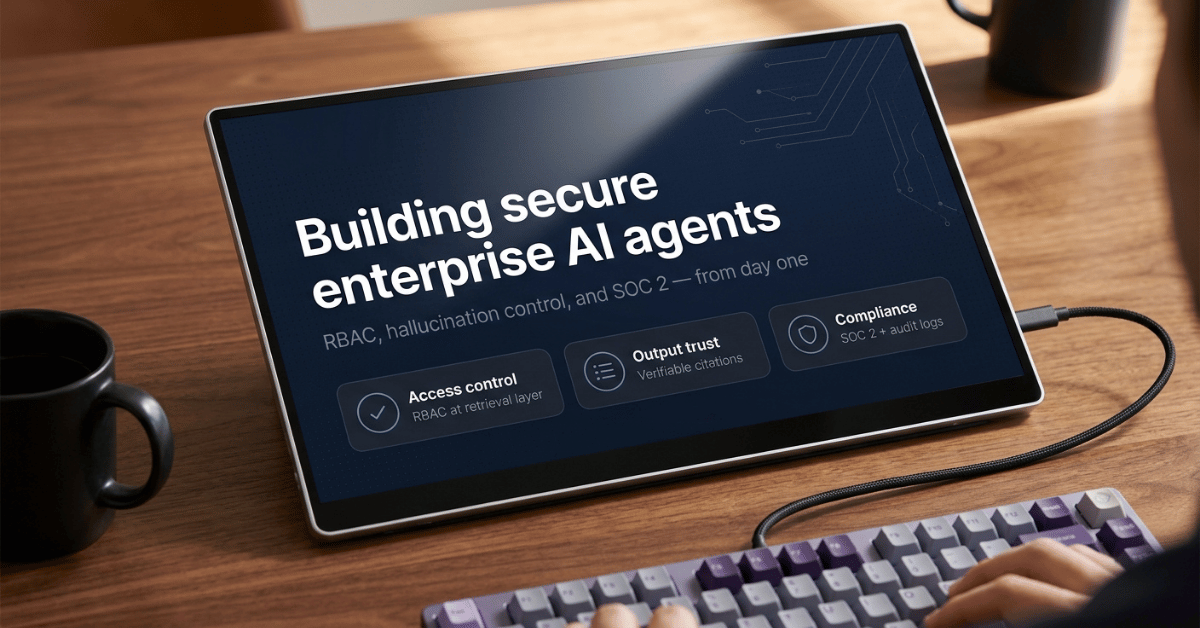
Deploying secure enterprise AI agents requires more than choosing the right LLM. Without fine-grained access control at the retrieval layer, hallucination mitigation, and full audit logging, an AI agent with access to your enterprise knowledge base becomes a data leak waiting to happen. This article covers the three architectural pillars every enterprise must have before deploying a custom AI agent.
Why Is Enterprise AI Security Harder Than Standard Software Security?
Enterprise AI presents a unique paradox: AI agents deliver the most value when they have broad, unfettered access to company data, but that broad access is simultaneously your greatest security risk.
Standard security controls like IAM policies, API keys, and encryption do not address the AI-specific failure: an agent that queries everything regardless of who is asking. According to Gartner, 34% of enterprises have already experienced an AI-related security incident, heavily driven by shadow AI and misconfigured access controls.
Solving this requires a three-pillar framework: Access Control, Output Trust, and Infrastructure Compliance.
What Goes Wrong When Enterprises Build Custom AI Agents Without a Security Layer?
What Is the DIY AI Agent Trap?
Engineering teams using LangChain wrappers or raw OpenAI APIs typically ingest all company data– SharePoint, CRM, Google Drive, into one shared vector database.
A vector database has no concept of document ownership. Every employee query searches for the entire pool.
What Is the Permissions Bypass Problem?
THE PERMISSIONS BYPASS PROBLEM
Your SDR asks the AI: What do we know about Acme Corp? The agent correctly returns deal history.
Then they ask: What is our CEO’s compensation package?
Without RBAC for AI agents at the retrieval layer, the agent answers, because that document was in the SharePoint instance that was ingested. The original file permissions are bypassed entirely.
This is the default failure mode of every DIY AI agent using a shared vector store without retrieval-layer access control. The IBM Security Cost of a Data Breach Report puts the average enterprise breach at $4.45 million. But exposing unannounced M&A documents or HR records internally causes immediate damage before it ever hits a compliance report.
Pillar 1: How Does Fine-Grained Access Control Secure an Enterprise AI Agent?
What Is RBAC for AI Agents?
Role-Based Access Control (RBAC) must operate at the retrieval layer, not just at the application login level.
You need Fine-Grained Access Control (FGAC), which controls access at the individual document level. If an AI searches for an answer, the retrieval pipeline must mathematically filter out vector embeddings originating from documents the querying user cannot view.
How Should an AI Agent Inherit a User’s Existing System Permissions?
The architecture works via SSO inheritance: user authenticates via SSO → identity provider retrieves their permission set → permissions are applied as filters on every vector database query.
If the SDR cannot open the CEO compensation document in SharePoint, the AI agent cannot surface it, even if it exists in the vector store. At fifthelement.ai, FGAC and RBAC are core platform capabilities. We break down data silos intelligently, matching your existing entitlement rules.
What Does SSO-Linked Access Control Look Like in Practice?
User authenticates via Okta, Azure AD, or Google Workspace SSO.
Permission set pulled from the identity provider at query time. It is not cached or approximated.
Every AI query is scoped only to the documents that user’s identity can access in the source system.
Pillar 2: How Does Hallucination Control Protect Enterprises from AI Liability?
Why Are AI Hallucinations a Security and Compliance Risk?
In regulated environments like financial services, healthcare, and telecom, a confidently wrong AI output on a contract term is a liability. Under GDPR, compliance failures for incorrect data processing can result in penalties up to 4% of global revenue.
The risk scales up when AI queries proprietary documents it was not trained on, the exact scenario in enterprise RAG deployments. The Vectara Hallucination Leaderboard shows enterprise RAG models frequently hit 3% to 10% hallucination rates without strict retrieval grounding. Hallucination control AI is a hard requirement, not an optional feature.
What Are Verifiable Citations in Enterprise AI?
Every agent’s answer must include verifiable citations: the source document, the file path, and the exact excerpt.
Example format: Based on the Q3 2025 MSA (SharePoint/Legal/Contracts/Acme_MSA_Q3.docx), payment terms are Net 30.
This forces the user to verify the source before acting. fifthelement.ai guarantees “Answers you can trust.” Every output links to the source. This is a liability management mechanism. Contrast this with ungrounded tools like ChatGPT, which generate untraceable answers. That lack of traceability makes consumer tools unacceptable for AI agents in telecom or banking.
Pillar 3: What Auditability and Compliance Standards Does Enterprise AI Require?
Why Do CISOs Need Full Query Audit Logs?
For a CISO, AI observability and logging serve three critical functions: compliance evidence, incident response, and regulatory governance. The average cost of a data breach now hovers at $4.88 million (IBM Security Cost of a Data Breach Report). You cannot protect what you cannot see.
The minimum architectural requirement is a tamper-proof log detailing: what the AI was asked, what it answered, the source documents used, and who the human in the loop was, for every query, by every user.
What Does SOC 2 Compliance Mean for an Enterprise AI Agent Platform?
SOC 2 Type II compliance means an independent auditor verified the security controls across five trust principles. It is not self-asserted.
Evaluating vendors without a SOC 2 AI platform is a non-starter. The fifthelement.ai platform is SOC 2 compliant from day one. You do not wait for the platform to mature.
Does Your Enterprise AI Agent Train Your Proprietary Data?
No. fifthelement.ai does not use customer data to train public foundation models. We offer flexible deployment, on-premises, private cloud, or hybrid to meet data residency and sovereignty laws.
Should Enterprises Build or Buy the Security Infrastructure for Custom AI Agents?
The build trap forces engineering teams to write infrastructure instead of business logic. At fifthelement.ai, all three pillars are the platform foundation. Engineering teams customize the agent; they do not build the security layer. Read our full Build vs. Buy framework for custom enterprise AI agents to map the architectural tradeoffs.
Frequently Asked Questions
Q. What are the permissions of the bypass problem in enterprise AI agents?
The permissions bypass problem happens when an AI agent retrieves sensitive information from an unpartitioned vector database and shows it to a user who lacks the source system permissions to view that file.
Q. What is RBAC for AI agents and how does it work?
Role-Based Access Control for AI agents operate at the retrieval layer. It connects to the enterprise SSO to apply hard filters to vector database queries. The AI only searches document the specific user is authorized to read.
Q. How do verifiable citations reduce AI hallucination risk in enterprise deployments?
Verifiable citations force the AI to link outputs to a specific source document and file path. The human operator audits the exact excerpt of the AI used, preventing users from acting on fabricated information.
Q. What compliance certifications should an enterprise AI agent platform have?
Enterprise AI platforms should hold SOC 2 Type II certification to prove security, availability, and confidentiality controls have been independently audited.
Q. How long does it take to build enterprise AI security infrastructure from scratch?
Building retrieval-layer RBAC, citation pipelines, and comprehensive audit logging to achieve SOC 2 compliance takes 12 to 18 months of dedicated senior engineering time.
Stop trying to build complex AI security infrastructure from scratch. fifthelement.ai gives you the platform to deploy custom, highly secure enterprise AI agents with SOC 2 compliance and out-of-the-box RBAC, so your engineering team builds the agent, not the security layer.

