
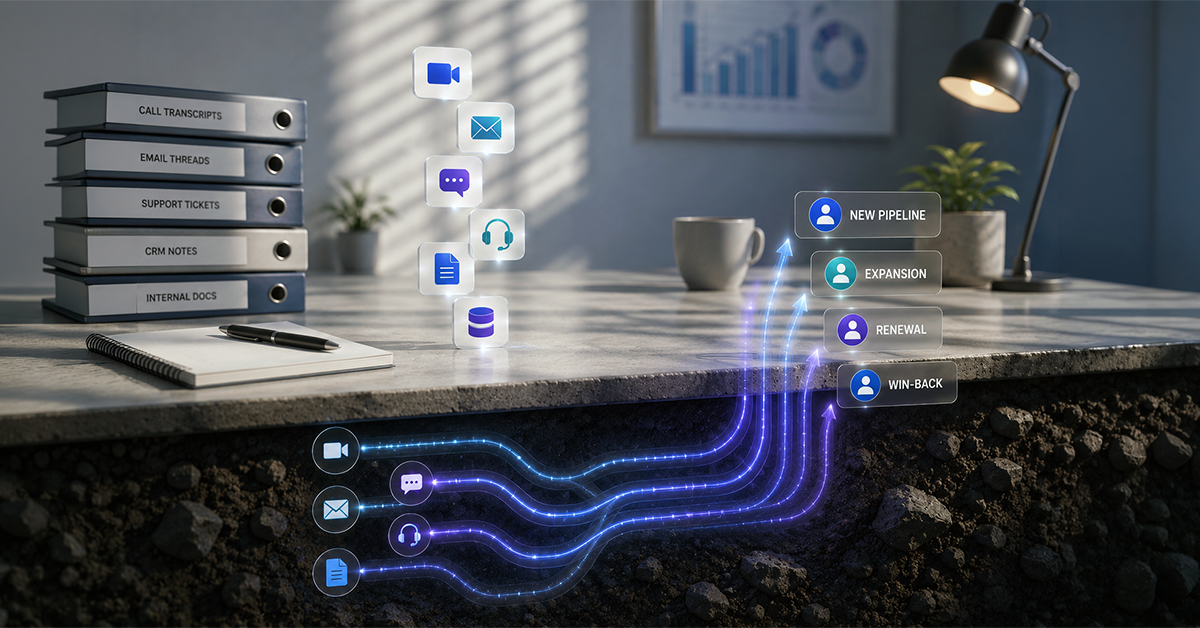
The most expensive pipeline in most enterprises is pipeline buried in owned data nobody searches. It sits in a support thread where a customer mentions a second business unit, in a call transcript where a churned account says the budget is back, in a CRM note logged against the wrong opportunity. Nobody hid it. Nobody read it either.
This page covers hidden pipeline detection in two parts: exactly how the detection works, and what it costs to turn on. You will learn which sources are monitored, how often they refresh, how a candidate signal is scored before anyone sees it, where the output lands, and the honest total cost including the work that is not the software.
Gartner’s May 2026 survey of 227 chief sales officers found organizations providing sellers with AI-enabled next best actions are 2.6x more likely to achieve commercial growth, and names signal monitoring among the activities AI is well suited to. Detection is half of that mechanism. Routing is the other half.
1. How Detection Actually Works
Hidden pipeline detection reads the conversation data a company already owns and identifies revenue opportunities that never became a CRM record. The inputs are specific: Calls, Emails, Tickets, Slack, Internal meetings. where account context accumulates.
The processing step is not a keyword match. Text is segmented into individual statements, each statement is classified against a defined set of revenue events, and the result is compared against the current CRM state for that account. A statement only becomes a candidate signal when it describes something the CRM does not already hold. A customer naming a sister division with its own budget is net-new pipeline. A churned account describing a failed replacement is a win back your churned customers motion. A support ticket describing a workaround the customer built themselves is support-as-revenue.
Every candidate is then attributed to an account and an owner of record. Without that step, pipeline generation output is a report rather than an action.
What the end user sees is an email. Delivery is email-native with zero new UI, addressed to the owner of record, containing the signal, the account, the source it came from, and the suggested next action. There is no new dashboard to check and no second login. Signals detected in a customer’s data belong to that customer and are not pooled into a shared dataset sold to anyone else.
2. How Detection and Scoring Work
Scoring exists to answer one question before a rep is interrupted: is this worth a human hour. The pipeline runs in discrete steps.
- Source connection. Read access is granted per source. Each connector inherits the customer’s existing RBAC/FGAC, so the system never surfaces content to a person who could not already open it.
- Statement extraction. Long documents are broken into discrete claims so that one relevant sentence inside a fifty-minute transcript is not diluted by the other forty-nine minutes.
- Classification. Each statement is labelled against the defined signal categories: net-new pipeline, cross-account intel, save motion, warm intro, deal risk, and support-as-revenue. Hidden pipeline draws mainly on the first two and the last.
- CRM comparison. The candidate is checked against existing opportunities, stages, and owner assignment. Anything the CRM already reflects is suppressed. This is the step that separates hidden pipeline from an alert feed.
- Confidence tiering. Candidates are banded rather than given a false-precision percentage. High confidence means an explicit, attributable statement of intent, need, or budget. Medium means a strong indication requiring rep judgment, for example a warm leads meaning discussion where the buyer is exploring rather than committing. Low is held back from routing and used only to inform.
- Deduplication. The same underlying event mentioned in a call, a ticket, and an email is collapsed into one signal with three sources attached.
- Routing. High and medium confidence signals go to the owner of record by email, with the source quoted so the rep can verify in seconds.
Gartner’s May 2026 buying group research, based on 645 B2B buyers, found groups with low dysfunction were 13x more likely to report high-quality deals. That is the argument for routing a scored signal to a person rather than firing an automated sequence at it.
3. A Worked Example
A B2B software company runs 14 quota-carrying AEs across 320 enterprise accounts, with an average contract value of 74,000 dollars. Sources connected: call transcripts, the shared sales and CS mailboxes, the support desk, and CRM notes. Weekly volume is roughly 400 calls and 1,100 tickets.
In week three, a support engineer resolves a ticket for a manufacturing customer. In the closing message the customer’s operations lead writes that their Mexico plant is running the same process manually and has asked for a quote from someone. The ticket closes. No CRM record is created.
Detection reads the ticket in the next batch cycle. Statement extraction isolates the sentence. Classification labels it net-new pipeline, new geography. CRM comparison finds one open opportunity on the parent account, US only, with no Mexico entity and no related opportunity. Confidence tiers high: named location, named process, stated buying activity. Deduplication finds the same plant referenced once in a QBR transcript six weeks earlier and attaches it as a second source.
The signal routes by email to the AE who owns the parent account, quoting both sources, the same day the ticket closes.
The AE re-qualifies the buying group rather than sending a sequence, and opens a 74,000 dollar opportunity in the Mexico entity within nine days.
Across a quarter at this volume, the realistic outcome is not a hundred new deals. It is a low double-digit number of qualified, sourced opportunities that would otherwise have closed with the ticket.
Start a free trial and connect one source to see what your own data returns.
4. What to Watch Out For
The failure mode here is not missed signals. It is too many.
False positives cluster in three places. Speculative language, where a customer says they might look at something next year. Third-party mentions, where a rep repeats what another vendor told them and the system reads it as a customer statement. And already-known opportunities, where the CRM holds the record but under a different account hierarchy, so the comparison step misses it. The first two are handled by confidence tiering and suppression of low-tier output. The third is a data hygiene problem in the CRM, not a detection problem, and it is worth fixing before you judge accuracy.
A rep should act on a high-confidence signal with a named person and a quoted source. A rep should discard anything without an attributable statement, and should feed that judgment back so the thresholds tighten.
The candid part is what happens after the email. Gartner’s May 2026 survey of 210 CSOs and senior sales leaders found AI tools save sellers an average of 4.8 hours per week, but 72 percent of sales organizations report low reinvestment of that time into high-value activity, which Gartner calls a reinvestment gap. Dan Gottlieb, VP Analyst in the Gartner Sales practice, puts it plainly: “AI is not the hero of this story; AI is the accelerant.”
Detection without a follow-up rhythm produces activity, not pipeline. The teams that get this wrong treat the signal email as the deliverable. The teams that get it right put a weekly review on the calendar and hold owners to a response window.
5. Where Revenue AI Signals Fits
The problem is pipeline buried in owned data nobody searches. Revenue AI Signals from fifthelement.ai is the layer that reads that data and routes what it finds.
Concretely: fifth connects to transcripts, mailboxes, support desks, CRM notes, and document repositories under read access that inherits your existing RBAC/FGAC. It classifies statements against the defined signal categories, compares each candidate against current CRM state so known opportunities are suppressed, tiers what remains by confidence, and emails the owner of record with the source quoted. SOC 2 (Type II), audit logs, SSO/SCIM, and encryption in transit and at rest apply throughout, with SaaS, VPC, and on-prem deployment available.
The use case is enterprise AEs and CS managers tracking buying-committee movement and pipeline continuity, where the risk is not a missing tool but an unread sentence.
“When pipeline looks thin, the instinct is to buy more signals. The signals are already in the building. They sit in tickets, CS calls and internal channels, and they expire because moving them is nobody’s job. Buying a shared dataset is easier than fixing that, which is precisely why it creates no advantage.”
~ Jonathan Garini, Founder and CEO, fifthelement.ai
On proof, be skeptical of latency and accuracy claims from anyone, including fifth. Detection here is scheduled batch, not streaming, and confidence is banded rather than expressed as a single precision figure. The logical next step is to connect one source and measure it against your own data.
6. Conclusion
Hidden pipeline detection reads the conversation data you already own, suppresses everything your CRM already knows, scores what is left by confidence, and emails the owner of record with the source attached.
Connect a single source, ideally your support desk, then measure what comes back over four weeks against opportunities you would otherwise have created. If you would rather scope it with someone first, contact sales and ask for a source-by-source walkthrough.
7. Frequently Asked Questions
Q1. How is hidden pipeline detected?
Conversation data the company already owns is segmented into individual statements, each statement is classified against a defined set of revenue events, and every candidate is compared against current CRM state. Anything the CRM already holds is suppressed. What remains is scored by confidence, attributed to an account and owner, and emailed to that owner with the source quoted.
Q2. Which data sources produce hidden pipeline?
Five sources produce most of it:
- Call and meeting transcripts
- Sales and customer success email threads
- Support tickets and their closing messages
- CRM free-text notes and activity capture
- Internal documents and wikis holding account context
Support tickets are consistently the most underrated of the five, because they close without ever creating a revenue record.
Q3. How accurate is hidden pipeline detection?
Accuracy is expressed as confidence tiers, not a single precision number. High confidence requires an explicit, attributable statement with a named person and quoted source. Medium requires rep judgment. Low is held back from routing. Accuracy degrades most when CRM account hierarchies are messy, because the comparison step then fails to recognize an opportunity that already exists.
Q4. Where is hidden pipeline delivered to the rep?
By email, to the owner of record. Delivery is email-native with zero new UI, so there is no new login, no dashboard to check, and no second inbox. Each message contains the signal, the account, the quoted source it came from, and a suggested next action, so the rep can verify the claim before acting on it.
Q5. How do you stop hidden pipeline from becoming noise?
Three mechanisms. Comparison against current CRM state suppresses anything already known. Confidence tiering holds low-tier candidates back from routing entirely. Deduplication collapses the same underlying event across multiple sources into one signal with several citations attached, rather than three separate emails.
Q6. Can hidden pipeline trigger a CRM workflow?
Yes. The honest caveat is that fifth proposes rather than writes silently: a signal can create a task or a proposed record for a human to accept, and teams that let it write unattended inherit every false positive directly into their forecast. Start with proposals, measure acceptance, and widen scope once the thresholds are calibrated.

