
Security review is where good AI deals stall. Not because the product failed, but because the buying team hits a stage nobody planned for: a questionnaire, a data-flow diagram request, a residency question, and three teams who have not yet met each other. This is normal. It is not a red flag, and it is not a signal that the vendor is hiding something.
This article is a field guide to that stage, written from the buyer’s side of the table. It covers what soc 2 compliance software review actually involves, the documents a vendor should already have ready, a realistic week-by-week timeline you can use to set expectations internally, a worked example of a review running end to end, and the findings that genuinely block deals rather than just slowing them.
If you are the champion and your deal just entered review, the fastest thing you can do is get the document set in front of security before the first call. The rest of this page tells you what should be in it.
What SOC 2 Compliance Software Actually Requires
SOC 2 compliance software is any system that stores, processes, or transmits customer data and is expected to demonstrate, through an independent attestation, that its controls operate as described. It is not a badge the software carries. It is evidence the vendor produces about how the software is run.
Three components make up the concept in practice. First, the Trust Services Criteria themselves: security, availability, processing integrity, confidentiality, and privacy, as published by the AICPA. Second, the report type. A Type I report covers whether controls were designed appropriately at a single point in time. A Type II report covers whether they operated effectively across a period. Those are not interchangeable, and asking for the wrong one is the most common early mistake in a review.
Third, the operating evidence behind the report: access control, logging, encryption, and change management, running continuously rather than assembled the week before the audit.
What is SOC 2 compliance for a B2B revenue team specifically? It is the difference between a security team approving a tool that reads sales conversations and a security team escalating it to legal.
What to Expect, Stage by Stage
An enterprise security review of an AI vendor typically runs three to six weeks for a standard risk tier and eight to twelve for a high tier, such as regulated financial services or anything touching cross-border personal data. The variable is rarely the vendor. It is how many internal teams must sign, and whether the documents arrived complete on day one.
A realistic sequence:
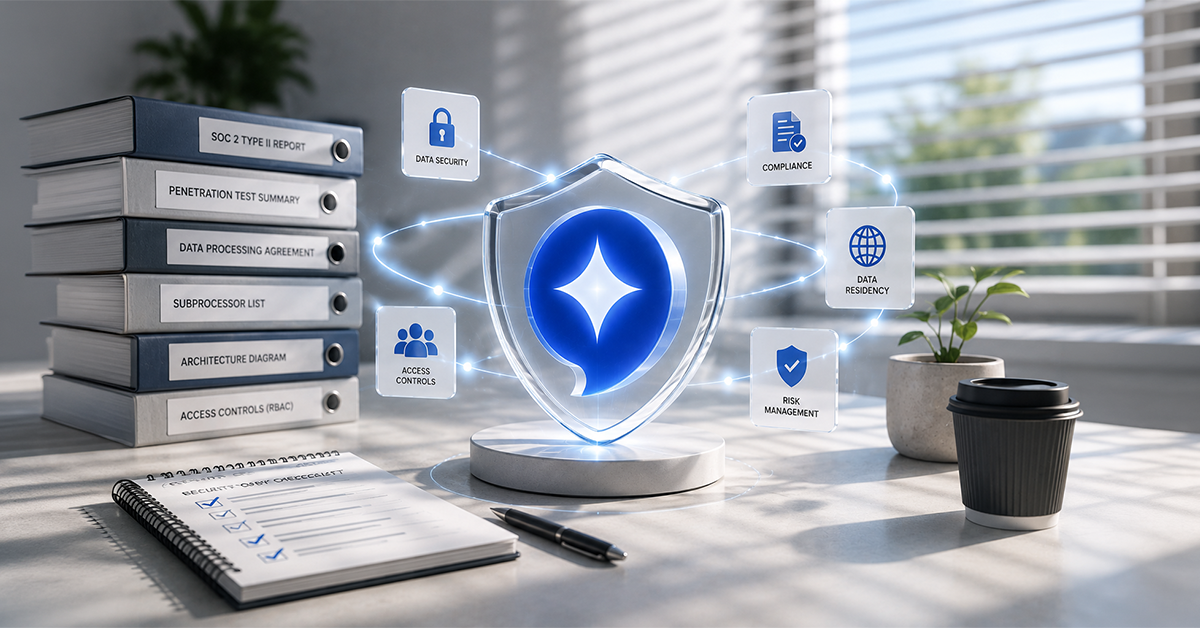
The documents a vendor should have ready before you ask:
For an agentic ai enterprise purchase, add two more: a written statement of what the system reads versus writes, and whether customer data is used to train shared models. Reviewers now ask both questions first.
Request the security pack. If a vendor cannot send this set within two business days, that itself is a finding.
A Worked Example
A 1,400-employee B2B software company, headquartered in Ireland with a US sales team, evaluates a Revenue AI purchase. Annual contract value is 96,000 euro. The deal is verbally agreed on 3 March and enters security review on 10 March. The buying group includes a VP RevOps as sponsor, an InfoSec analyst, a DPO, and a procurement manager.
Week 0. The champion requests the vendor pack rather than waiting for the questionnaire. Seven documents arrive in two days and are circulated before the kickoff call. This alone removes the usual ten-day round trip.
Week 1. The 180-question questionnaire comes back complete, with four items marked not applicable and a written reason for each. InfoSec reviews the data-flow diagram and raises one question: where does inference run for EU-resident data.
Week 2. Access model review. The team maps role based access control to their existing identity groups over SSO/SCIM, then restricts one sales-leadership role at field level. Audit logs are exported to their own tooling for a sample period.
Weeks 2 to 3. Legal reviews the DPA and the sub-processor list. Two sub-processors process customer content. The DPO requires notice terms on sub-processor change, which the vendor accepts as a contract amendment rather than a product change.
Week 3. Findings issued: three documentation gaps, one real remediation item on log retention duration, with an agreed 30-day date.
Week 4. Procurement closes. Total elapsed time: 26 days against an internal estimate of six to eight weeks. One remediation item carried into the contract with a date attached, which is the normal outcome rather than the exceptional one.
What to Watch Out For
The findings that actually block deals are rarely the questionnaire answers. They are these.
Data residency and cross-border processing. This is now the dominant blocker for AI purchases, and reviewers are right to press on it. Gartner predicts that by 2027, more than 40 percent of AI-related data breaches will be caused by improper use of generative AI across borders, with VP Analyst Joerg Fritsch attributing unintended transfers to “insufficient oversight” when GenAI is embedded into products without clear disclosure. If you cannot say which region processes inference, expect a hold.
Data governance, not just perimeter security. A Q3 2024 Gartner survey of 248 data management leaders found 63 percent of organizations either do not have, or are unsure whether they have, the right data management practices for AI, and Gartner predicts organizations will “abandon 60% of AI projects” unsupported by AI-ready data through 2026. Reviewers have absorbed this. Expect questions about source-system scoping and retention, not only firewalls.
Regulatory timing for EU buyers. The EU AI Act (Regulation 2024/1689) applies in phases. Prohibitions and AI literacy obligations applied from 2 February 2025, governance and general-purpose AI model obligations from 2 August 2025, and Article 50 transparency obligations and general application from 2 August 2026. Following the Digital Omnibus political agreement, high-risk obligations for stand-alone Annex III systems were deferred to 2 December 2027, and to 2 August 2028 for AI embedded in regulated products. As of publication, per the European Commission. This timeline has moved twice in twelve months, so date-stamp any deadline you cite internally.
The candid part: some findings cannot be answered with a document. A missing control is a missing control. The honest resolution is a remediation date in the contract, not a longer PDF. Teams that treat review as a paperwork exercise are the ones who get surprised in week three.
Where Revenue AI Signals Fits
The problem this article opened on, security and data-residency review blocking the deal, is solvable by preparation rather than persuasion. That is how fifthelement.ai approaches it for Revenue AI Signals.
fifthelement.ai publishes a security pack as a product artifact rather than a sales document, so a champion can hand it to InfoSec before the first review call. It covers SOC 2 (Type II), the RBAC/FGAC model and how it inherits from existing identity groups via SSO/SCIM, audit logs available for export, encryption in transit and at rest, and deployment options across SaaS, private cloud (VPC), and on-prem, which is what makes the residency answer concrete rather than conditional.
For the review questions specific to an agentic system, the pack states what the agent reads, what it writes, and the boundary between the two, plus a written position on whether customer content is used to train shared models.
“If the security pack is a sales document, nobody owns the gap between what it claims and what the platform does. If it is a product artifact, someone does. We would rather carry that cost internally than hand it to a customer’s compliance team.”
~ Jonathan Garini, Founder and CEO, fifthelement.ai
The proof offered here is the pack itself. Read it and judge the control environment, rather than taking a claim about it.
Conclusion
An enterprise security review is a documentation and evidence exercise with a small number of genuine control questions inside it, and the deals that move fastest are the ones where the vendor’s pack reached security before the first meeting. Soc 2 compliance software buyers do not need a longer sales conversation at this stage. They need the file.
Request the security pack for Revenue AI Signals and hand it to your security team before the review kicks off. If you would rather walk through the control model with someone, contact sales and ask for a security-led session.
Frequently Asked Questions
Q1. What does an enterprise security review cover?
It covers the vendor’s control environment, its data handling, and its contractual commitments. In practice: the SOC 2 report, penetration test results, the access and authentication model, encryption, logging, sub-processors, retention and deletion, deployment and processing location, and the data processing agreement. For AI vendors, it also covers what the system reads and whether customer data trains shared models.
Q2. Which documents should a vendor supply upfront?
The SOC 2 Type II report under NDA, the most recent penetration test summary with remediation status, the data processing agreement, the sub-processor list, an architecture and data-flow diagram, the RBAC/FGAC model, and the deployment options with residency implications. Supplying these before the questionnaire arrives typically removes a full week of back and forth.
Q3. How long does security review add to the sales cycle?
Expect three to six weeks for a standard risk tier and eight to twelve for a high tier such as regulated finance or cross-border personal data. The length depends less on the vendor than on how many internal teams must sign and whether documents arrived complete. Incomplete first submissions are the single largest source of delay.
Q4. What are the most common blockers?
Data residency and cross-border processing, unclear scoping of which source systems the tool reads, retention and deletion terms, sub-processor change notice, and a real control gap surfaced by the questionnaire. Gartner’s prediction that improper cross-border generative AI use will drive more than 40 percent of AI-related data breaches by 2027 is why residency now leads the list.
Q5. Who signs off internally?
Typically four groups. Information security owns the control review and issues findings. IT or identity owns SSO/SCIM and the access model. Legal or the data protection officer owns the DPA, sub-processors, and transfer mechanism. Procurement owns the contract and any security addendum. The RevOps or sales sponsor coordinates and holds the timeline.
Q6. What should be in a vendor security pack?
Four items, in priority order. One, the current SOC 2 Type II report. Two, the architecture and data-flow diagram showing processing and storage location. Three, the DPA with the sub-processor list attached. Four, the access model covering role based access control, field-level restrictions, and audit logging. Everything else is supporting detail.

