

Conversational intelligence (CI) is software that uses natural language processing (NLP) to analyze speech or text conversations to derive data-driven insights. However, in the modern era, CI has evolved beyond passive transcription by utilizing Agentic AI to actively execute tasks, update CRM fields automatically, and route cross-functional revenue signals to the right teams.
The Evolution of Conversational Intelligence
The Problem: Traditional conversational intelligence software only transcribes sales calls, creating passive dashboards that force reps to spend 40% of their week doing manual data entry.
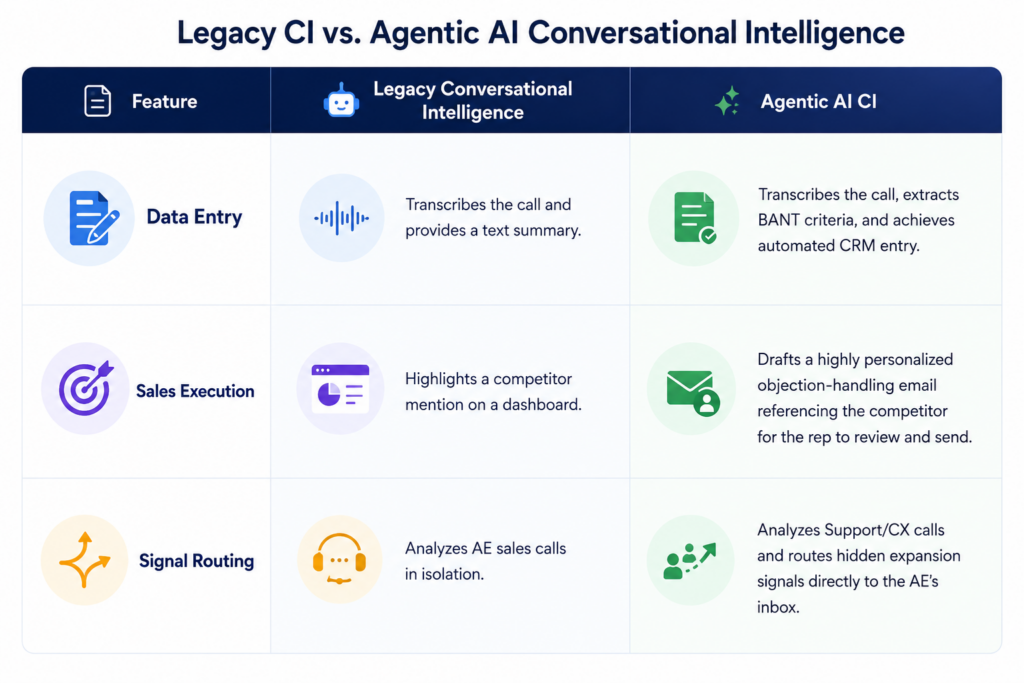
The Solution: Agentic AI has shifted CI from passive analytics to active execution. Modern tools act as digital workers that listen, reason, and update your systems automatically.
The Value: By analyzing cross-functional data (like support tickets and emails), modern CI captures hidden expansion signals and ensures zero-touch CRM hygiene.
The ROI: Revenue teams stop acting as the “Human API,” allowing AEs to spend more time selling and less time doing admin work.
In the era of Generative AI, simply transcribing a Zoom call and getting coaching tips on talk-to-listen ratios is no longer enough. The standard has fundamentally shifted. The future of conversational intelligence isn’t just analyzing conversations; it is using Agentic AI to act on them. If your tech stack is only giving you a transcript, you are leaving pipeline and productivity on the table.
Here is how conversational intelligence has evolved, and why modern revenue teams need active AI agents, not just passive recording tools.
The Traditional Definition: What Conversational Intelligence Used to Be
When the “first wave” of conversational intelligence software (the Gong and Chorus era) entered the market, it solved a massive and very real problem. Before these tools, sales managers were completely blind to what was happening on the front lines unless they were actively riding shotgun on a call.
First-generation CI tools brought visibility to the revenue floor. By applying early natural language processing (NLP) to call recordings, managers could finally see what reps were actually saying. They could track competitor mentions, monitor objection handling, enforce talk tracks, and review talk/listen ratios. It was a revelation for sales coaching.
The Limitation: It was entirely passive. First-generation conversational intelligence is a “destination platform.” It gives you a highly accurate transcript and a beautiful dashboard, but it stops there. The sales rep is still forced to act as the “Human API.” After the call ends, the rep still has to log into Salesforce or HubSpot, manually update the deal stages, type out the discovery notes, and write the follow-up email.
The Problem with Legacy CI: Silos and Manual Labor
Relying on passive conversational intelligence creates two massive bottlenecks for modern revenue organizations: manual data entry and hidden pipeline silos.
The “Human API” Problem: Because traditional conversational intelligence tools do not actually execute tasks, sales reps are drowning in administrative work. Industry studies consistently show that reps spend up to 40% of their week doing data entry, CRM updates, and internal admin. They read the call summary, and then do the manual labor of transposing that information into the system of record. This manual pipeline management drains selling time and inevitably leads to CRM decay.
The Missing Pipeline Problem: Traditional CI was built for the sales floor, meaning it almost exclusively analyzes scheduled AE Zoom meetings. But the most valuable conversations—churn risks, competitor mentions, and massive expansion opportunities—rarely happen in a scheduled sales pitch. They happen in Customer Support tickets, Zendesk chats, and routine Customer Success reviews.
Because legacy tools only look at the sales funnel, they miss these cross-functional signals entirely. To truly understand your customer, you need the ability to analyze customer support conversations and connect those operational interactions back to your revenue engine.
The Shift: From Conversational Analytics to Agentic AI
The solution to the “Human API” problem is a shift from passive analytics to Agentic AI. In the context of B2B sales, Agentic AI refers to digital workers that listen, reason, and execute.
Powered by Large Language Models (LLMs), Agentic AI doesn’t just read a transcript to highlight a keyword. It understands the business context of the conversation and takes autonomous action on behalf of the rep. It transforms conversational intelligence from a coaching dashboard into an active member of your RevOps team.
3 Ways fifthelement.ai Redefines Conversational Intelligence
At fifthelement.ai, we believe that AI in sales should reduce your workload, not add another dashboard to check. By transforming passive data into active execution, our platform redefines how revenue intelligence tools operate in the enterprise.
1. Zero-Touch CRM Hygiene
Sales reps hate data entry, and RevOps leaders hate empty CRMs. Fifth’s Revenue AI removes the burden of manual data entry entirely. By deeply understanding the context of your customer interactions, our Agentic AI extracts critical deal criteria (like BANT—Budget, Authority, Need, Timeline) and pushes that data directly into structured fields. This allows organizations to effectively automate CRM hygiene, ensuring flawless pipeline data without relying on the rep’s memory.
2. Cross-Silo “First Party” Intent Data
The most powerful revenue signals often happen outside the sales department. Fifth breaks down organizational silos by connecting Service AI and Revenue AI. For example: A customer submits a routine support ticket, and casually mentions they are standing up a new office in London next quarter. Traditional CI misses this. Fifth’s AI catches the geographical expansion signal, recognizes the revenue potential, and instantly routes an alert to the owning AE.
3. Flawless Accuracy in Complex Environments
Not all enterprise conversations are simple, straightforward discovery calls. They are often messy, filled with technical jargon, multiple speakers, and nuanced objections. Fifth is built for complex B2B environments. With strict hallucination control and enterprise-grade security, our RevOps AI ensures that the data being written to your CRM is accurate, trustworthy, and contextually sound.
Frequently Asked Questions:
Conversational intelligence typically refers to software that records and analyzes spoken interactions (like a sales call) for coaching and visibility. Revenue intelligence is a broader category that aggregates data from calls, emails, CRM data, and cross-functional support tickets to provide a holistic view of deal health, pipeline accuracy, and revenue forecasting.
NLP to provide keyword tracking. Modern Agentic AI improves conversational intelligence by adding reasoning and execution. Instead of just highlighting a pricing objection, LLMs can understand the context of the objection, update the CRM’s forecast stage, and draft a follow-up email addressing the specific pricing concern.
es. While legacy conversational intelligence software required manual data entry, modern Agentic AI tools can achieve automated CRM entry. They extract structured data (like next steps, decision criteria, and budget) directly from call transcripts and email threads, writing it directly to your CRM without manual rep intervention.
Conclusion: Stop Transcribing, Start Executing
If your conversational intelligence tool just gives you a transcript and a talk-to-listen ratio, you are paying for an outdated solution. In the era of AI agents, your tech stack should be working for you, not creating more administrative homework for your sales team.
From ensuring perfect CRM data to actively mining your support tickets for expansion revenue, modern AI is about execution. And as your organization matures, you can even take this a step further by deploying an AI SDR to act on these conversational signals autonomously.

Stop settling for passive dashboards
See how fifthelement.ai’s Revenue AI turns everyday conversations into automated pipeline and perfect CRM hygiene

