

Support ticket revenue signals is any cue in a customer or internal conversation that indicates revenue opportunity or risk – such as an expansion mention, a competitor reference, or an anti-signal that a healthy-looking deal is slipping. Zero-UI delivery: the signal arrives in the named rep’s inbox with full context and a suggested next action – no new dashboard, no new login, no behavior change. Unlike shared third-party tools, it works from a company’s own conversations and delivers same day.
Introduction: The Hidden Pipeline in Customer Support
Support ticket revenue signals is any cue in a customer or internal conversation that indicates revenue opportunity or risk – such as an expansion mention, a competitor reference, or an anti-signal that a healthy-looking deal is slipping.
Right now, enterprises are leaking pipeline simply because they cannot process the conversations they already own. According to other vendors, 87% of enterprises missed their 2025 revenue targets despite record AI spending. The core problem is data capture and signal synthesis. A typical 6,000-word sales call produces a 40–60-word CRM summary – meaning your CRM captures under 1% of what was actually said.
When you apply this failure rate to support tickets, the gap widens exponentially. Customers routinely mention new projects, changing budgets, or competitor trials to support agents while troubleshooting. Because these buried thread signals never reach the account executive (AE), the revenue is lost, or competitive risks go unnoticed. Revenue AI Signals fixes this by turning everyday support interactions into structured, actionable first-party intent data.
Why this matters in 2026
The market is shifting rapidly towards Agentic AI and category consolidation. B2B revenue teams can no longer afford to maintain bloated, disconnected technology stacks.
As budgets tighten and acquisition costs rise, revenue leaders must find expansion of revenue support within their existing customer bases. Third-party intent data is no longer enough to maintain a competitive edge. Your competitors are buying the exact same third-party lists from the exact same vendors. First-party intent data extracted directly from your own customer support interactions, is completely exclusive.
If your AI for support tickets only focuses on case deflection or agent assistance, you are missing its highest-value application. It is time to surface expansion revenue directly from the conversations your customers are already having with your frontline team.
What is support ticket revenue signals?
Definition: support ticket revenue signals is any cue in a customer or internal conversation that indicates revenue opportunity or risk – such as an expansion mention, a competitor reference, or an anti-signal that a healthy-looking deal is slipping.
No single source provides a complete view of a strategic account. Signal synthesis combines cues across calls, tickets, chat, and email to surface pipeline risk that no single source reveals.
For example, when a customer emails support about configuring single sign-on for a new regional office, Revenue AI detects the expansion revenue support cue. It understands the business context of that technical request and routes that specific intelligence directly to the account owner, bridging the historic gap between service delivery and sales.
Step-by-step: How it works
Connecting a resolved support ticket to an open pipeline opportunity requires a systematic mechanism. Agentic AI handles ingestion, classification, and routing automatically.
Here is exactly how Revenue AI extracts signals from resolved support tickets and active conversations to create tangible sales pipelines.
- Ingest: The platform continuously reads across six data sources, including open and closed support tickets, emails, call transcripts, and CRM notes.
- Classify: AI models detect buried-thread signals and categorize them into six specific revenue-signal categories.
- Route: The system cross-references the CRM, identifies the correct account owner, and delivers the signal via Zero-UI.
- Update CRM: Zero-touch CRM hygiene automatically updates the relevant Salesforce or HubSpot opportunity, eliminating manual data entry for reps.
Signal Extraction and Routing Process
What fields / signals it can handle
Revenue AI Signals classifies conversation cues into actionable data points. It does not just flag a ticket; it extracts the specific intelligence required to advance a deal or reduce deal risk with AI.
The agentic AI layer updates CRM fields without rep effort. This zero-touch CRM hygiene ensures that pipeline forecasts reflect reality, capturing vital nuance that drop-down menus traditionally miss.
Supported Revenue Signals
How it differs from traditional automation
When evaluating support ticket revenue signals vs revenue intelligence, the coverage gap is stark. Traditional automation and revenue intelligence platforms focus on entirely different data sets, leaving support tickets ignored.
Zero competitor coverage exists for this specific workflow. Other vendors read scheduled calls only – not support tickets. Other vendors read external account-level web signals – not internal support tickets.
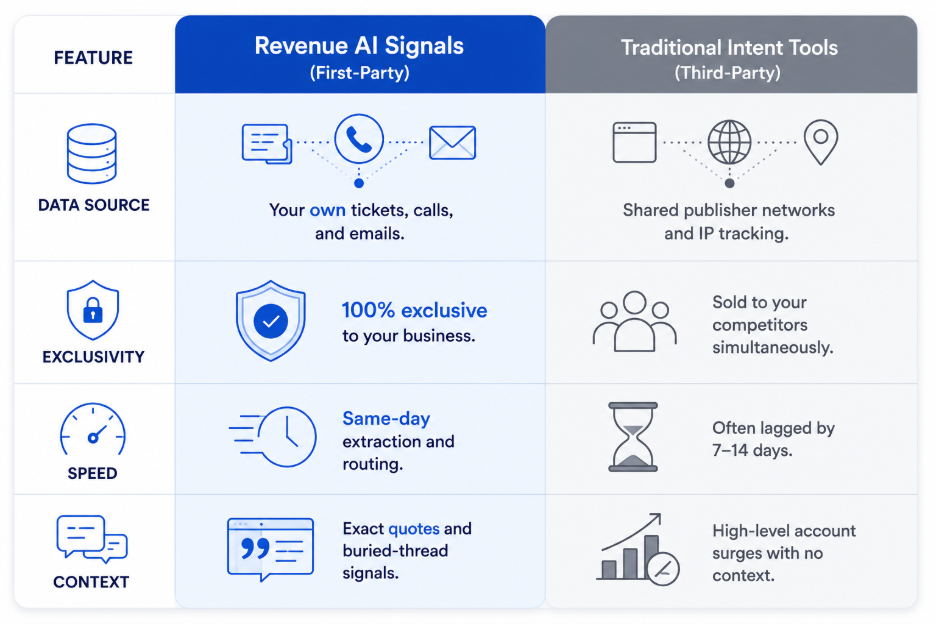
Support ticket revenue intelligence’ and ‘buried-thread signal’ are fifthelement.ai-originated terms because we built the platform to read the data others ignore. Revenue AI Signals works from first-party conversation data, not shared third-party co-op signals. The intelligence you gather from your support tickets is exclusive, highly contextual, and delivers same-day.
First-Party vs Third-Party Intent Data
Enterprise requirements
Enterprise IT, RevOps, and CIOs require strict governance before connecting AI to sensitive customer support and sales data. Revenue AI Signals is built expressly for complex, regulated environments where data privacy is paramount.
Enterprise governance is standard, not an add-on. The platform maintains SOC 2 Type 2 compliance. It enforces strict role-based access control (RBAC) and fine-grained access control. This ensures account executives only see signals for the specific accounts they own.
Furthermore, deployment requires zero change management for the sales team. The platform features native integration with Salesforce and HubSpot. Signals route directly to the rep’s inbox via Zero-UI.
FAQs
Q. Can AI surface expansion revenue opportunities from support tickets?
Yes. A buried-thread signal is an expansion or risk cue sitting several paragraphs deep in a resolved support ticket, invisible to tools that read only scheduled calls. Revenue AI scans these interactions, identifies buying intent, and routes the intelligence to the account executive.
Q. What is a buried-thread signal in a support ticket?
A buried-thread signal is a revenue-impacting statement hidden deep within a routine customer conversation. For example, a customer resolving a technical issue might mention a forthcoming regional rollout. Traditional AI ignores this, but Revenue AI extracts it as a high-value signal.
Q. How does Revenue AI extract signals from resolved support tickets?
The platform ingests unstructured text from your support ticketing system. Agentic AI models parse the text against six specific revenue-signal categories. When it identifies a match, it extracts the exact quote and context, transforming unstructured text into first-party intent data.
Q. How does an expansion signal from a ticket get routed to the AE?
Signal routing relies on Zero-UI signal delivery. Once the AI extracts a signal, it cross-references your CRM to find the current account owner. It then delivers an email directly to that AE containing the context, the exact customer quote, and a suggested next action.
Q. Can Revenue AI read both open and closed support tickets?
Yes. Revenue AI can read both open and closed support tickets. Customers frequently mention strategic shifts in tickets that are eventually closed with routine technical resolutions. Analyzing historical and open tickets ensures no revenue signal is lost in the archives.
Q. What percentage of expansion revenue opportunities come from support interactions?
While percentages vary by industry, support interactions represent the highest volume of first-party engagement post-sale. Because customers speak candidly to support agents, these tickets frequently contain the earliest indicators of account growth, stakeholder changes, and pipeline risk.
Q. How do you connect a resolved support ticket to an open pipeline opportunity?
You connect them through signal synthesis and native CRM integrations. When Revenue AI extracts a signal from a ticket, it pushes that data directly into Salesforce or HubSpot. Using zero-touch CRM hygiene, the AI updates the relevant opportunity fields and alerts the AE automatically.
Conclusion
Support ticket revenue signals are any cue in a customer or internal conversation that indicates revenue opportunity or risk. By relying solely on third-party intent data and scheduled call recordings, revenue teams are walking past the most valuable expansion of revenue hidden in their own systems.
Revenue AI Signals transforms your existing support tickets into an exclusive, same-day pipeline engine. It extracts the buried-thread signals, categorizes them, and routes them to the right rep via Zero-UI. Your CRM stays updated, and your team acts on real intelligence- not guesswork.
Stop losing revenue in the gap between your conversations and your CRM.
Book a demo to see Revenue AI Signals run on your own data.

