
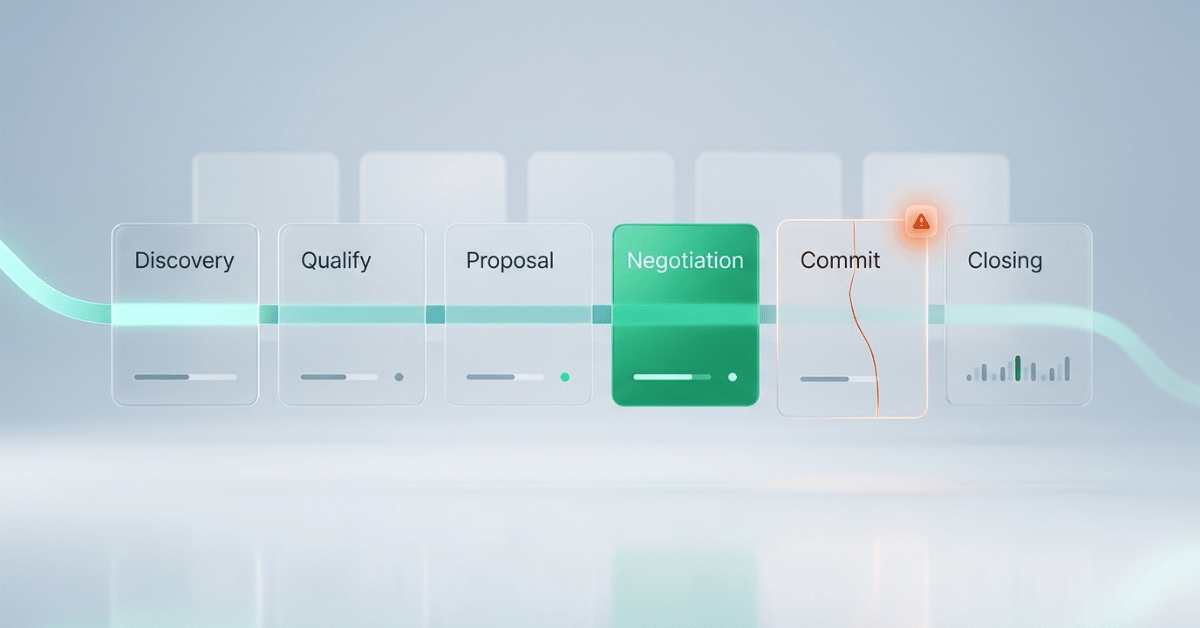
AI deal risk detection is the automated process by which Agentic AI turns conversation content into structured CRM updates or routed actions without rep effort. Zero-UI delivery means the signal arrives in the named rep’s inbox with full context and a suggested next action – no new dashboard, no new login, no behavior change. Unlike shared third-party tools, it works from a company’s own conversations and delivers same day.
Key Takeaways:
- First-party intent data: AI deal risk detection works from first-party conversation data, not shared third-party co-op signals.
- Zero-UI routing: Signals surface same day and route to the named owner via Zero-UI – no new dashboard required.
- Zero-Touch CRM Hygiene: Agentic AI keeps the CRM current automatically, mapping call data to standard Salesforce and HubSpot fields.
Introduction
AI deal risk detection is the automated process by which Agentic AI turns conversation content into structured CRM updates or routed actions without rep effort.
In B2B sales, the gap between what happens in a meeting and what is recorded in the CRM is where revenue is lost. Data shows that a typical 6,000-word sales call produces a 40–60 word CRM summary. This means the CRM captures under 1% of what was actually said. Important nuances, hesitant tones, and offhand mention of competitors simply vanish into the ether.
When critical information is missing, revenue leaders make decisions based on blind spots. Despite record AI spend across the industry, 87% of enterprises missed their 2025 revenue targets. Human data entry cannot keep pace with the volume of daily omnichannel conversations. By the time a pipeline review identifies a stalled deal, the opportunity to save it has usually passed.
AI deal risk signals solve this gap by listening to the exact words spoken and written by prospects across your entire ecosystem. This guide explains how anti-signal sales detection works, how it differs from traditional revenue intelligence, and how enterprise teams use it to protect pipeline.
Why this matters in 2026
The B2B sales technology landscape is undergoing a fundamental shift towards Agentic AI. For years, revenue teams relied on fragmented technology stacks that presented data on disparate dashboards. Operating these fragmented stacks- often a combination of conversational intelligence, sales engagement, and forecasting tools- costs roughly $240,000 per 100 reps per year.
This legacy model relies entirely on humans logging into dashboards, interpreting transcripts, and manually updating fields. It is expensive and highly prone to failure. If a customer mentions a budget freeze during a routine customer success call, the sales representative rarely finds out in time. The signal is buried in a ticket the account executive will never see.
Deal risk AI 2026 moves beyond passive dashboards. Instead of expecting representatives to hunt for insights, Agentic AI brings the insight directly to the representative. This approach removes the data entry burden while running a continuous save motion across all active pipeline. Category consolidation means teams no longer need separate tools for call recording and pipeline forecasting; signal synthesis does the heavy lifting automatically.
What is AI deal risk detection?
AI deal risk detection is the automated process by which Agentic AI turns conversation content into structured CRM updates or routed actions without rep effort. It operates on the principle of signal synthesis. Signal synthesis combines cues across calls, tickets, chat, and email to surface pipeline risk that no single source reveals on its own.
An anti-signal is a specific type of pipeline risk native to this methodology. It is a risk indicator that appears in live conversation data while the CRM still shows the deal as healthy.
By identifying these anti-signals early, Revenue AI Signals route the context to the appropriate deal owner. This allows the team to initiate a save motion before the prospect formally disengages or signs with a competitor.
Step-by-step: how it works in practice
Traditional revenue intelligence platforms require users to learn new interfaces. Agentic AI deal risk detection operates invisibly in the background. To understand how AI detects deal risk in sales, we can track the process from raw conversation to routed action in four distinct steps.
The Workflow:
- Ingest
- Classify
- Route
- CRM Update
The Mechanism
| Step | Input | Output |
| 1. Ingest | Raw transcripts from calls, emails, support tickets, and internal Slack/Teams messages. | Secure, unified text data tied to specific CRM accounts and contacts. |
| 2. Classify | Unified text data evaluated against risk models and historical deal patterns. | An identified anti-signal (e.g., prospect mentions evaluating a competitor or an executive sponsor departing). |
| 3. Route | The classified anti-signal and its exact source citation. | A Zero-UI notification sent directly to the named deal owner’s inbox or Slack, complete with a suggested save motion. |
| 4. CRM Update | Verified signal data mapped to standard CRM fields. | Zero-Touch CRM Hygiene automatically updates the opportunity stage, notes, and BANT fields in Salesforce or HubSpot. |
A Practical Enterprise Scenario
Consider a complex enterprise software deal at day 60. The account executive has logged the deal in Salesforce as “Commit” for the current quarter.
However, during a routine technical discovery call with a sales engineer- which the AE did not attend- the prospect’s IT director mentions that their internal compliance review board has pushed all new vendor approvals to next quarter.
In a traditional setup, if the sales engineer forgets to slack the AE or log this specific detail in the CRM, the deal remains marked as “Commit.” The CRO forecasts revenue, only to be blindsided on the last day of the quarter.
With AI deal risk detection, the system ingests the technical call transcript, classifies the phrase “pushed all new vendor approvals” as a timeline anti-signal, and routes a Zero-UI alert directly to the AE’s inbox the same day. It also updates the close date in Salesforce automatically. The AE immediately executes the save motion, engaging the executive sponsor to bypass the IT delay.
What fields and signals it can handle
Revenue AI Signals process unstructured conversations into structured data. They identify both hard metrics and soft conversational cues. Because the system analyses first-party intent data, it adapts to the specific language used by your buyers, rather than relying on generic third-party web scraping.
Zero-Touch CRM Hygiene extracts the following categories from conversations and writes them directly to CRM fields without rep effort:
| Field / Signal Type | Data Source | Example Conversational Cue |
| BANT Criteria | Sales calls, Email threads | “Our budget for Q3 has been frozen pending the merger.” (Budget Risk) |
| Stakeholder Changes | LinkedIn, Email, Calls | “Sarah is moving to a new role next week; I will be taking over.” (Champion Loss Risk) |
| Competitor Mentions | Support tickets, Sales calls | “We are also looking at how Vendor X handles SOC 2 compliance.” (Competitive Risk) |
| Next Steps | Internal meetings, Calls | “Let us reconvene next Tuesday after the board meeting.” (Timeline Update) |
This continuous background processing ensures that pipeline reports reflect reality. It eliminates the friction of manual data entry, giving revenue operations leaders accurate forecasts based on actual prospect behavior rather than representative optimism.
How it differs from traditional automation
The market is saturated with intent data and conversation intelligence tools. However, most rely on either shared third-party data or passive dashboards, creating distinct limitations for modern revenue teams.
Traditional conversation intelligence tools like Gong cover deal risk via AI Tracker and Deal Boards, which report up to 35% higher win rates. Account-based marketing platforms like Demandbase or 6sense cover churn detection via predictive third-party intent data (tracking what prospects search for on the broader web).
Neither of these legacy approaches covers the true anti-signal concept.
An anti-signal occurs when the CRM shows a deal is healthy, but your own live conversation data says danger. Third-party intent data cannot hear a prospect to express hesitation on a Zoom call. Passive conversation dashboards require a manager to actively log in, search for hesitation, and build a report.
fifthelement Revenue AI Signals bypass these limitations by delivering first-party, exclusive insights via Zero-UI directly to the representative who can act on them.
| Feature | Traditional Platforms (e.g., Gong, Demandbase) | fifthelement.ai Revenue AI Signals |
| Data Source | Third-party co-op data or isolated transcripts. | First party and exclusive conversation data across six internal sources. |
| Delivery Mechanism | Requires logging into a separate, proprietary dashboard. | Zero-UI delivery directly to the user’s existing email inbox or Slack. |
| Signal Type | Lagging churn metrics or broad topic interest. | Live conversation anti-signals and hyper-specific deal risk cues. |
| Actionability | Requires human interpretation and manual CRM entry. | Agentic AI triggers the save motion and automatically updates Salesforce/HubSpot. |
Enterprise requirements and governance
Enterprise IT and security teams demand stringent governance for AI tools accessing internal communications. Tools that lack strict access controls fail security audits instantly.
AI deal risk detection must be built for enterprise governance from the ground up. The fifthelement platform is SOC 2 Type 2 certified and relies on robust role-based access control (RBAC) and fine-grained access control. This ensures that users only see signals for accounts they are legally and internally authorized to view.
For example, the Atlas Copco deployment of Revenue AI was approved by their Global IT cybersecurity board precisely because of these strict data isolation measures. The system features native integrations with Salesforce and HubSpot, ensuring that data flows securely without requiring complex, vulnerable middleware.
Crucially, hallucination prevention is built into architecture. All signals are grounded strictly in the customer’s own first-party data. Every alert includes direct citations and links back to the original source transcript, ensuring representatives act on facts, not AI assumptions.
FAQs
- How does AI detect deal risk in sales?
In short, this comes down to how signals are sourced and delivered. Revenue AI Signals reads sales calls, emails, external meetings, support tickets, internal chat (Slack/Teams), and internal meetings, classifies each cue, and delivers it via Zero-UI to the right owner the same day. These signals are first-party and exclusive – extracted from a company’s own conversations, so no competitor can license or see them.
- What is an anti-signal in B2B sales?
An anti-signal is a risk indicator that appears in conversation data while the CRM still shows the deal as healthy – it triggers ‘the save motion’ before the deal is lost. It is different from a churn flag because it is detected in live conversation language, not in lagging CRM or usage metrics.
- Why does CRM data miss deal risk signals from conversations?
CRM data consistently misses deal risk signals because it relies entirely on manual human data entry. A typical 6,000-word sales call produces a mere 40–60 word CRM summary, capturing under 1% of the actual conversation. AI deal risk detection bypasses this bottleneck by reading raw conversation data directly and updating the CRM automatically via Agentic AI.
- What is the save motion in Revenue AI?
Revenue AI is the use of Agentic AI to detect revenue signals inside a company’s own conversations and route each to the right person, automatically. When an anti-signal fires, the platform routes it to the deal owner the same day. This immediate, Zero-UI notification prompts the “save motion”-a strategic intervention executed by the sales representative before the deal formally stalls or drops out of the pipeline.
- How does anti-signal detection work in practice?
In practice, anti-signal detection works by continuously monitoring first-party intent data. If a buyer mentions a budget freeze on a Zoom call or in an email thread, the AI categorizes this cue, maps it to the relevant Salesforce or HubSpot opportunity, and sends an alert with source citations to the deal owner.
- Can Revenue AI surface deal risk from CS conversations as well as sales calls?
Yes, Revenue AI can surface deal risk from Customer Success conversations. In fact, many critical anti-signals- such as complaints about technical blocks, executive sponsor departures, or competitor mentions- happen during routine CS calls or within support tickets. Agentic AI captures these cues and routes them to the sales account owner immediately.
- How does anti-signal differ from a standard churn risk signal?
An anti-signal differs from a standard churn risk signal because it surfaces proactively in live conversation language, rather than reactively in lagging usage metrics or manual CRM flags. This allows revenue teams to execute the save motion while the prospect is still actively engaged, rather than trying to save an account after they have already made the decision to churn.
Conclusion
AI deal risk detection is the automated process by which Agentic AI turns conversation content into structured CRM updates or routed actions without rep effort. By moving away from passive dashboards and sharing third-party intent data, revenue teams can finally capture the 99% of conversation data that never makes it into the CRM.
Using first-party signals, Zero-UI delivery, and automated zero-touch CRM hygiene, fifthelement Revenue AI Signals ensure that anti-signals are caught early. This allows sales representatives to execute the save motion before a deal is lost to a competitor or budget freeze.
Stop losing deals to blind spots hidden in your own conversation data.
Book a demo to see how Revenue AI Signals can surface anti-signals in your stack today.

