

AI in B2B sales is the deployment of autonomous, knowledge-grounded artificial intelligence to handle complex buyer discovery, automate technical RFP responses, and enable account executives with instant, accurate data. Unlike basic generative AI that simply writes emails, enterprise AI sales agents can securely reason across a company’s entire tech stack and document library turning a 3-week RFP process into a 3-hour review, and a 2 AM technical question into a booked meeting.
For the past two years, revenue leaders across manufacturing, telecom, fintech, and enterprise SaaS have been selling a false promise. The market said AI would revolutionize B2B sales. Instead, enterprise tech stacks are now cluttered with tools that create friction instead of pipelines.
Look at what landed:
- High-Volume Spam: AI bots blasting 1,000 generic cold emails a day, burning a total addressable market and alienating the technical buyers you most need to reach.
- Basic Routing Widgets: Rule-based chatbots that ask, “What is your company size?” but cannot answer whether your API supports a buyer’s legacy billing system.
- Walled Gardens: CRM-native tools that cannot securely access data in SharePoint, Zendesk, or a 200-page RFP PDF sitting in a vendor’s inbox.
Complex B2B sales do not need more top-of-funnel noise. Selling a $500,000 SaaS platform, a 5G core network, or an industrial automation contract requires AI that can read a 50-page technical PDF, parse an engineering diagram, and deliver instant, accurate answers to a CTO evaluating your solution at midnight.
The market has been running on Phase 1 GenAI. It is time to move to Phase 2: Autonomous Enterprise Agents.
What Is AI in B2B Sales?
AI in B2B sales is the deployment of autonomous, knowledge-grounded artificial intelligence to handle complex buyer discovery, automate technical RFP responses, and enable account executives with instant, accurate data. Unlike basic generative AI that simply writes emails, enterprise AI sales agents can securely reason across a company’s entire tech stack and document library.
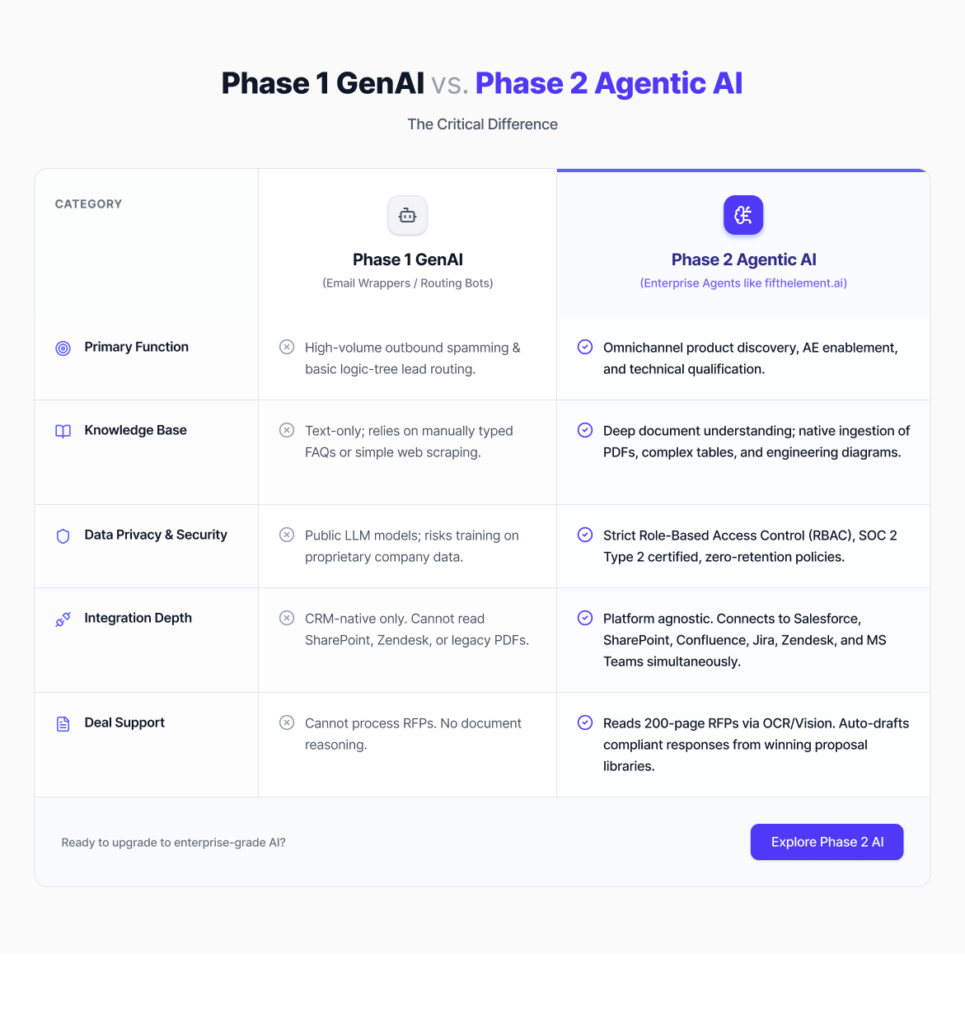
To understand why this distinction matters, revenue leaders need to see the full gap between Phase 1-point solutions and Phase 2 platform-agnostic agents.
Phase 1 GenAI vs. Phase 2 Agentic AI: The Critical Difference
What’s Wrong with Today’s AI Sales Tools?
The first wave of AI for B2B sales failed not because AI is immature, but because vendors-built solutions for the wrong problem. Here are why the three dominant archetypes collapse under real enterprise sales conditions.
The Cold Email Trap: Volume vs. Value
AI BDR platforms promise pipelines at scale. What they deliver is noise on scale. Technical buyers at CIOs at financial institutions, lead engineers at telecom operators, procurement directors at industrial manufacturers identify AI-generated outreach in seconds. They do not want a personalized-sounding email about “pain points.” They want to know if your platform can handle their specific legacy authentication system, or whether your billing module supports convergent charging across mobile and fixed lines.
A 2026 Gartner study found that 75% of B2B buyers describe their most recent purchase as “very complex or difficult.” Mass-volume AI outreach is designed for commodity sales. It is the wrong tool for a $400K enterprise contract with a 12-month sales cycle.
The Routing Bot Limitation: Triage vs. Discovery
A technical buyer evaluating telecom network infrastructure does not want to answer, “How many employees does your company have?” Before talking to a human. They want to know right now, at 11 PM, whether your AAA server support RADIUS and Diameter simultaneously, and what your migration path looks like from a Cisco CPAR end-of-life environment.
Rule-based routing bots cannot answer those questions. They escalate to an SDR who is offline. The buyer leaves. The opportunity dies. Basic chatbots are designed for lead triage, not deep product discovery and in complex B2B sales; discovery is everything.
The Walled Garden Problem: CRM Lock-In
Relying entirely on CRM-native AI, tools that only see what lives inside Salesforce or HubSpot, ignores a fundamental enterprise reality: your most valuable deal-closing knowledge does not live in your CRM. It lives in:
- SharePoint spec sheets that a solutions engineer drafted three years ago
- Zendesk ticket histories that reveal exactly how a similar customer’s deployment challenge was solved
- PDF proposals from the last five enterprise wins that show precisely how to position against your main competitor
- Jira roadmaps that answer whether the feature a prospect needs is six weeks or six months away
A truly platform-agnostic enterprise AI agent must orchestrate across all these systems simultaneously, not just the ones your CRM vendor has decided to support.
What Does Real Enterprise AI in B2B Sales Actually Do?
Replacing point-solution thinking with an enterprise agent model changes what AI can contribute across the entire revenue cycle. fifthelement.ai has defined three core pillars where autonomous agents drive measurable pipeline impact.
Pillar 1: Omnichannel Product Discovery (The Inbound AI SDR)
An enterprise AI agent acts as a Level 1 Sales Engineer available 24 hours a day, 7 days a week. It does not answer FAQ snippets. Its reasons across the company’s full technical catalog pricing tables, engineering diagrams, compliance sheets, and product roadmaps to give accurate, cited answers to highly specific buyer questions.
For a telecom operator evaluating AAA consolidation at 2 AM, the agent answers whether the platform supports EAP-SIM/AKA authentication for Wi-Fi offload, cites the exact technical specification, and books a meeting with a solutions engineer on the next available calendar slot. The buyer gets an answer before any competitor has even woken up.
Real-World Example: Atlas Copco, a global industrial manufacturing company, deployed fifthelement.ai to handle inbound product discovery across a deeply complex, multi-language technical catalog. Buyers who previously had to wait for a distributor callback now get accurate, cited answers in seconds. Atlas Copco’s Global IT cybersecurity team reviewed and approved the platform before rolling out.
Pillar 2: Internal Sales Enablement (AE Assist)
Account Executives in complex B2B environments spend over 30% of their working time hunting for information: searching SharePoint for the right case study, scrolling through Gong transcripts to find what a competitor said in a previous meeting, cross-referencing product documentation to answer a specific technical objection.
An internal AI agent collapses this friction. An AE preparing for a critical discovery call with a FinTech CRO can ask: “What is our exact positioning against Competitor X for a financial services compliance use case, and which of our past wins are most comparable?” The agent pulls a cited, accurate answer in seconds sourced from product marketing PDFs, Salesforce opportunity records, and meeting transcripts without exposing sensitive data to unauthorized team members.
This is not marginal efficiency. If your AE team has 20 reps each spending 12 hours per week in information retrieval, you are losing 240 hours of selling time every single week. Enterprise AI sales enablement converts that overhead directly into pipelines.
Pillar 3: Complex Deal Support (RFP & Proposal Automation)
For enterprise deals in telecom, fintech, or industrial manufacturing, RFP response is one of the most resource-intensive activities in the sales cycle. A single complex RFP can consume three weeks of cross-departmental effort across sales, product, legal, and finance.
Through deep document understanding including OCR and vision models that interpret scanned compliance tables, complex Excel matrices, and dense engineering diagrams enterprise AI agents read the full RFP, cross-reference the company’s library of past winning proposals, and auto-draft a compliant, accurate response. The AI does not guess. Every claim map to a source document.
What previously took three weeks of cross-departmental coordination becomes a three-hour review-and-approve process. For an operator responding to five major RFPs per quarter, this is a structural competitive advantage, not a marginal productivity gain.
Example: Revolut and Bank of Ireland deployed fifthelement.ai for legal compliance search and workflow automation in highly regulated financial environments. The platform’s strict zero-retention policies and source-citation model gave legal and compliance teams the confidence to adopt AI without data liability risk.
What Should CROs and CIOs Demand from Any AI Sales Platform?
Enterprise AI sales deployments involve three different buying stakeholders: the revenue leader who cares about pipeline, the RevOps leader who cares about data hygiene and process efficiency, and the CIO or CISO who will block the deployment if security requirements are not met. A credible enterprise AI platform must satisfy all three.
Non-Negotiable 1: Zero Hallucinations
In B2B sales, a hallucinated feature capability or an invented discount figure is not just an embarrassment it is a legal liability and a deal-killer. Generic AI systems guess when they do not know. Enterprise-grade AI must operate on deterministic grounding.
Hallucination control means every answer provided by the AI includes an inline citation linked directly to the exact source document or system record it drew from. If the AI does not have a verified answer, it says so and flags the question for a human expert. This is not optional in regulated industries. It is the minimum requirement.
Non-Negotiable 2: Enterprise-Grade Security (RBAC)
An AI system that can access your entire knowledge base must also respect every permission boundary in your organization. A junior BDR must not see enterprise pricing tiers. A website visitor must not trigger access to internal competitive positioning documents. A support agent must not pull up account information for a customer they are not authorized to service.
fifthelement.ai enforces Role-Based Access Control (RBAC) and Fine-Grained Access Control (FGAC) that maps directly to the organization’s existing identity provider and Active Directory structure. Users only receive outputs generated from data they are explicitly authorized to see. The platform is SOC 2 Type 2 certified and GDPR compliant meeting the requirements of banking, healthcare, and telecom environments where data residency and audit trails are non-negotiable.
Non-Negotiable 3: Messy Data Capabilities
B2B enterprise knowledge is almost never cleanly formatted. It lives in scanned spec sheets with handwritten annotations, Excel tables with merged cells spanning multiple rows, engineering diagrams that a text-only AI cannot interpret, and decades-old PDFs that were never designed for machine reading.
An enterprise AI platform must possess deep document understanding: the ability to use OCR and computer vision to parse these formats accurately, extract structured meaning from unstructured layouts, and reason across them without losing critical technical specifications. If your AI cannot read a scanned compliance matrix, it cannot support your RFP process. Full stop.
The 2026 Mandate: Autonomous Agents Win Complex Sales
The era of the cold email wrapper is over. The winning B2B sales teams in 2026 will not be the ones sending the highest volume of automated outreach. They will be the organizations that provide instant, accurate, and deeply technical buying experiences through autonomous enterprise agents.
For a telecom operator evaluating a 5G core modernization, the winning vendor will be the one whose AI answered a specific Diameter protocol question at 11 PM accurately, with a citation and booked a meeting before the RFP deadline. For an industrial manufacturer with a 5,000-SKU product catalog, the winning vendor will be the one whose AI guided a distributor to the exact right configuration in three minutes, not three phone calls.
The shift from GenAI assistants to autonomous enterprise agents is not a future consideration. It is happening right now, in your competitors’ pipelines.
Ready to See It? Stop settling for basic chatbots and email wrappers. See how fifthelement.ai’s Revenue AI can transform your complex sales cycle.
Frequently Asked Questions:
No, but the threshold is organizational complexity, not just company size. If your sales cycle involves technical RFPs, multiple stakeholder approvals, or a product catalog that requires domain expertise to navigate, an enterprise AI agent adds material value. fifthelement.ai works with mid-market companies as well as global enterprises. The qualifying factor is whether your buyers need accurate, technical answers, not just automated volume.
A basic chatbot follows a decision tree: it routes leads, collects emails, and answers pre-written FAQ responses. A enterprise AI agent reason across your entire knowledge base, PDFs, CRM records, SharePoint documents, and meeting transcripts to generate accurate, cited answers to questions that were never pre-programmed. It can also take actions: updating CRM fields, booking meetings, drafting proposals, and surfacing deal risk signals.
At minimum: SOC 2 Type 2 certification, GDPR compliance, Role-Based Access Control (RBAC), and a zero-retention data policy confirming that your proprietary data is never used to train public models. For regulated industries (banking, healthcare, telecom), also ask about Fine-Grained Access Control (FGAC), audit log capabilities, and on-premises or Virtual Private Cloud (VPC) deployment options.
A focused deployment connecting to your primary knowledge sources and configuring RBAC can be completed in 4 to 8 weeks for most mid-market environments. More complex deployments involving legacy data ingestion, custom CRM workflow orchestration, or heavily regulated environments typically run 10 to 16 weeks. fifthelement.ai offers fixed-scope professional services packages for initial data ingestion to minimize deployment risk.
Three primary KPI categories: Revenue impact (pipeline influenced, deal velocity improvement, RFP win rate change), Cost reduction (AE time recaptured from information retrieval, SDR hours redirected from qualification to closing), and Risk reduction (reduction in proposal errors, compliance incidents, and hallucinated claims in customer-facing responses). fifthelement.ai provides an ROI framework.

