

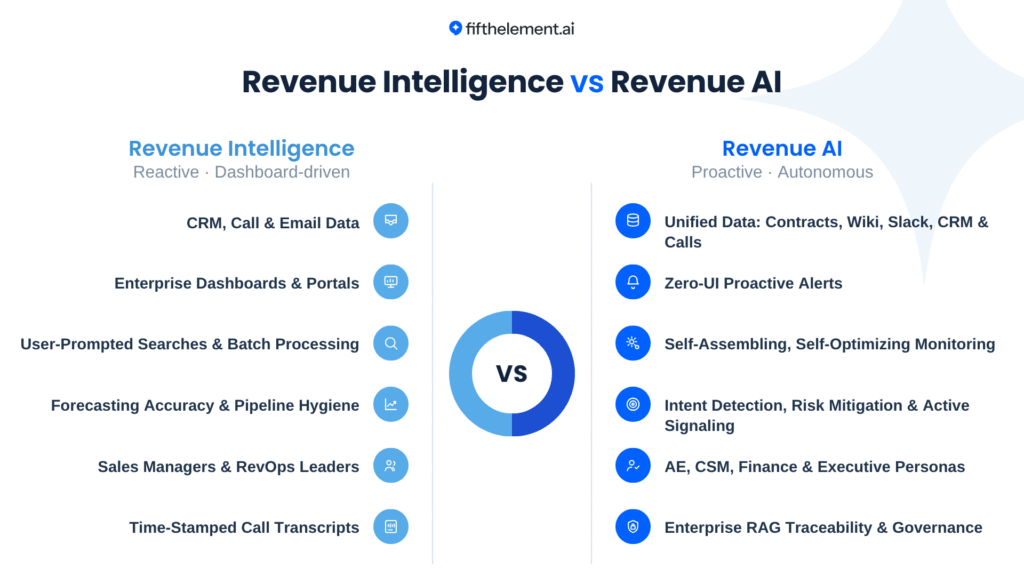
- When comparing Revenue AI vs Revenue Intelligence, Revenue Intelligence relies on structured CRM data and conversational recordings delivered through dashboards to help managers forecast and review past activities.
- Revenue AI utilizes autonomous agents and real-time monitoring across all unstructured enterprise data to detect signals without requiring user prompts.
- While revenue intelligence tracks logged calls, Revenue AI detects buying intent and expansion risks buried in unstructured support tickets, legal contracts, and Slack threads.
- Revenue AI delivers insights via a zero-UI model, pushing proactive alerts directly to reps, so they never have to pull a report.
Enterprise sales teams have spent the last five years building massive tech stacks that nobody wants to log into. When evaluating Revenue AI vs Revenue Intelligence, it is clear why this happened: we bought software to record calls, track pipeline changes, and score leads, hoping it would make forecasting a perfect science. Instead, we gave Account Executives another dashboard to monitor and another reason to avoid their CRM.
The conversation has now shifted. The market is moving away from passive reporting tools toward systems that do the heavy lifting for you. If you are evaluating your technology investments for the coming year, understanding the transition from backward-looking analytics to proactive, automated agents is non-negotiable.
Here is exactly how the categories differ, and why the shift matters for enterprise revenue teams.
Why Everyone Is Talking About Revenue AI
The dashboard model has reached a breaking point. RevOps teams have done incredible work centralizing data, but the burden of discovery still falls entirely on the human. If a mid-market deal stalls, a sales manager has to actively open a platform, search for a call transcript, and scan a specific keyword to figure out what went wrong.
Revenue AI flips this architecture entirely. Instead of waiting for a human to run a query, modern platforms constantly read the room. They sit across your entire enterprise stack, monitoring risk and opportunity, and alert the right person at the moment a signal drop. The current market hype is not about building a slightly better reporting chart. It is about reclaiming the hours reps waste hunting for context across ten different tabs.
What Is Revenue Intelligence? (Definition, How It Works, Limitations)
Revenue Intelligence is software that captures sales activity- primarily emails, calendar invites, and recorded meetings- to improve pipeline visibility and forecasting accuracy. It centralizes quantitative data, so revenue leaders have a historical view of dealing with health and rep performance.
When it emerged, this category solved a massive problem: reps were terrible at updating the CRM. By automatically logging calls and emails, Revenue Intelligence gave managers a reliable baseline of activity. It is highly effective at answering historical questions. For example, managers can easily ask, “Did the rep mention pricing on yesterday’s call?” or “Has the close date pushed more than twice?”
However, traditional Revenue Intelligence has three distinct limitations that have set the stage for the next evolution:
The unstructured data blind spot: It focuses almost entirely on voice and video interactions. It ignores the critical context hidden in legal redlines, support tickets, and internal Slack threads.
Dashboard dependency: Insights live in a separate portal. Reps have to break their workflow, log in, navigate a menu, and actively hunt for information.
Reactive analysis: It excels at forensic analysis of what happened yesterday but struggles to proactively alert you to cross-functional risks happening right now.
Tired of digging through dashboards to find out why a deal stalled? Book a Demo to see proactive alerting in action.
What Is Revenue AI? (Definition, How It Works, Core Components)
Revenue AI is an enterprise intelligence layer that continuously analyses unstructured data across your entire company to surface buying intent, churn risks, and expansion opportunities.
It works by connecting disparate silos- Salesforce, HubSpot, Slack, Zendesk, Jira, and SharePoint. It reads the text, understands the context of the conversation or document, and routes the findings directly to the people who need them. Instead of requiring manual searches, it utilizes autonomous agentic workflows to run these evaluations in the background 24/7.
The core components of a true Revenue AI platform include:
Unstructured Data Parsing: The ability to read and interpret complex text in contracts, support logs, and technical wikis, not just spoken dialogue.
Continuous Monitoring: An always-on engine that does not require a user to hit “search” or run a weekly report.
Zero-UI Delivery: Alerts pushed directly to Slack, Teams, or the CRM. There is no new dashboard for the sales floor to learn.
Enterprise RAG: Traceability is mandatory. Every insight must include a citation linking back to the exact source document, so reps trust the output.
RBAC Governance: Strict Role-Based Access Control ensures users only see the signals they are authorized to view, keeping enterprise data secure.
Revenue AI vs Revenue Intelligence (The Comparison)
How Revenue AI Changed Sales (Before vs After)
To understand the difference, consider a typical enterprise renewal motion.
Before: An Account Executive is preparing for a Q3 renewal call with a major financial client. They do their homework the traditional way. They check Salesforce to ensure the activity metrics look fine. They ask the Customer Success Manager via Slack if there are any glaring issues; the CSM says the client has been quiet but stable. Finally, the rep skims the transcript of the last recorded check-in call on their Revenue Intelligence dashboard. Everything looks green. The rep goes into the call expecting a straightforward renewal conversation, only to be blindsided by the buyer complaining about persistent API rate limits that are breaking their internal workflows. The deal immediately goes at risk.
After: Three days before that same renewal call, the AE receives a proactive Slack alert. The Revenue AI platform detected a highly technical complaint filed in a Jira ticket by the client’s lead engineer. The alert cites the exact ticket, summarizes the frustration, and suggests a technical workaround based on internal SharePoint documentation. Armed with this context, the rep loops in a Sales Engineer, addresses the API limits in the first five minutes of the renewal call, and secures the contract. They never had to log into a dashboard to find the information.
Why Traditional Revenue Intelligence Misses Critical Signals
Traditional platforms operate on a flawed assumption: they assume that if a detail matters to a deal, it will be spoken out loud on a Zoom call with a sales rep.
Enterprise buying simply does not work that way. The signals that make or break million-dollar deals live in the unstructured spaces your call recorder cannot reach. A legal team pushing back on a specific data privacy clause in a heavily redlined Word document is a critical buying signal. A champion asking a highly specific implementation question in a shared Slack connect channel is a signal. An end-user filing a frustrated support ticket about user permissions is a signal.
Because legacy tools cannot read and contextualize these disparate data source types, they leave revenue leaders with massive blind spots. You get a perfect transcript of your own sales pitch but completely miss the warning signs flashing in customer support.
Revenue Signals Explained (Intent, Expansion, Risk)
A revenue signal is a qualitative indicator of what an account is going to do next. Revenue AI monitors these signals across three distinct categories:
Intent Signals: Indicators that a prospect is actively evaluating a solution. For example, a prospect downloads a technical whitepaper, and a day later, their IT director emails a specific question about SOC 2 compliance. Revenue AI helps teams identify buying signals early, routing the context to the AE immediately so they can strike while interest is high.
Expansion Signals: Clues that an existing account has outgrown its current contract. If a customer support ticket asks how to provision twenty new users, this triggers continuous signal detection, alerting the account manager to an immediate upsell opportunity before the client starts looking at competitor pricing.
Risk Signals: Early warnings of churn. This could be a sudden drop in executive email engagement, a champion leaving the company, or a spike in severe IT tickets that indicate the product is failing to deliver value.
Revenue AI Use Cases
The shift to this technology impacts the entire go-to-market organization, not just sales leadership.
- Sales: Account Executives receive immediate, zero-UI alerts on buying intent. If a prospect interacts with high-value technical documentation, the AE gets a Slack message detailing the interaction, allowing them to engage prospects at the exact moment of high interest with relevant context.
- RevOps: Operations teams can automate complex CRM updates and surface hidden pipeline risks without forcing the sales floor to adopt new data-entry habits. The AI acts as an invisible administrative assistant, keeping the data clean without human intervention.
- Customer Success: CSMs no longer rely on quarterly check-ins to gauge account health. The platform scans support threads for tone and frustration, flagging accounts for intervention weeks before a formal churn conversation happens.
- Executives: CROs gain an unvarnished, cited view of account health across the entire business. They can view risk factors based on actual customer interactions across all departments, removing the subjectivity of rep-led pipeline reviews.
Revenue AI Trends for 2026
The enterprise tech stack is rapidly consolidating around proactive systems. We are seeing a massive shift toward AI Copilots that actively manage account strategy rather than just drafting polite follow-up emails or summarizing meetings.
The most significant trend is the death of the dashboard. Zero-UI delivery will become the baseline expectation for any new sales tool. If your reps have to open a new tab, navigate a menu, and remember a password to get the value out of a platform, they simply will not use it. Furthermore, as enterprise buyers get smarter about artificial intelligence, the conversation is shifting heavily toward data security. Buyers are demanding strict guardrails to ensure sensitive account data never bleeds across permissions.
Choosing the Right Revenue AI Platform
When evaluating platforms for 2026, the technology must match the reality of enterprise security and rep behavior. Use this checklist to separate true Revenue AI from legacy intelligence tools:
Unstructured Data Ingestion: Can it natively read tickets, wikis, and contracts, or does it only transcribe calls?
Zero-UI Capabilities: Does it push actionable alerts directly to Slack or Teams?
Citation & Traceability: Does it use retrieval-augmented generation to prove its claims, or does it ask you to blindly trust the AI’s summary?
Data Security: Is enterprise AI governance built in? Can it enforce strict RBAC, so reps only see their own accounts?
Accuracy Controls: Does it offer robust hallucination control designed specifically for regulated enterprise environments?
Cross-functional Integrations: Does it connect natively to Zendesk, Jira, Confluence, and SharePoint, or is it isolated to your CRM?
Why Modern Enterprise Teams Are Moving Beyond Revenue Intelligence
Revenue Intelligence solved a very specific problem: it gave managers visibility into the pipeline. Revenue AI solves a much harder problem: it helps you execute on that pipeline.
By expanding the data aperture to include all unstructured enterprise knowledge and delivering insights autonomously, modern sales organizations are moving from looking in the rearview mirror to anticipating the road ahead. fifthelement.ai provides the architecture to make this transition secure, fully explainable, and immediately actionable for your reps.
Stop searching for signals and start acting on them.
Frequently Asked Questions
Q. Is Revenue AI the same as Revenue Intelligence?
No, they are distinct categories. Revenue Intelligence relies on structured CRM data and call recordings viewed through dashboards. Revenue AI analyses all unstructured enterprise data- such as tickets, wikis, and contracts- and delivers proactive insights directly to the rep via zero-UI alerts.
Q. What changed when Revenue AI arrived in sales?
Sales shifted from reactive reporting to proactive execution. Revenue AI unlocks unstructured data sources like support tickets, legal contracts, and Slack threads that Revenue Intelligence cannot access. This allows teams to detect intent and risk before a deal actually stalls.
Q. What does Revenue Intelligence do that Revenue AI does not?
Revenue Intelligence excels at structured pipeline reporting and historical quantitative forecasting. It is highly effective for managers reviewing logged activities. Revenue AI and Revenue Intelligence serve as complementary tiers; one tracks the numbers; the other uncovers the qualitative context.
Q. Which teams need Revenue AI vs Revenue Intelligence?
Revenue Intelligence is primarily for Sales and RevOps to manage forecasting and pipeline hygiene. Revenue AI serves Sales, Customer Success, Finance, and Executives by providing real-time, cross-functional signal coverage across the entire enterprise stack.
Q. Does Revenue AI replace Clari or Gong for forecasting?
No- it complements them. fifthelement.ai adds an unstructured signal layer that sits alongside existing tools. While forecasting tools tell you the quantitative state of your pipeline, Revenue AI tells you exactly why a deal is at risk based on qualitative data.
Q. What is the cross-functional signal layer in Revenue AI?
It is an intelligence layer that detects buying or churn intent across systems outside the CRM. Examples include support tickets indicating churn risk, legal redlines signaling buying intent, and Slack messages revealing internal champion priorities across the business.
Want to uncover hidden pipelines in your unstructured data? Book a demo and explore Revenue AI with fifthelement.ai today.

