
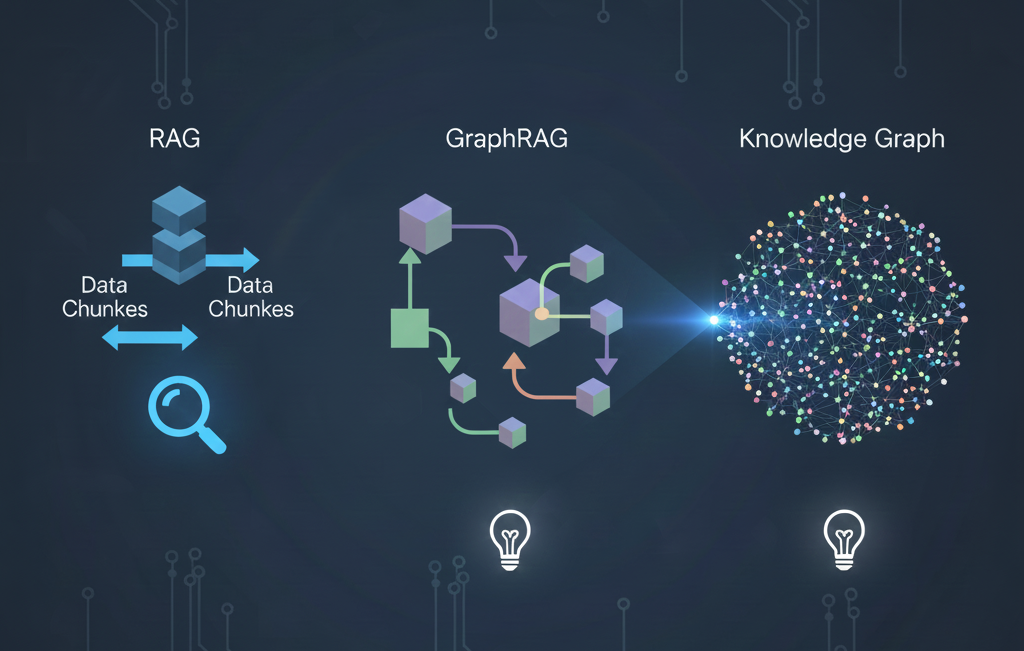
“Retrieval Augmented Generation” (RAG) is undoubtedly the buzzword of the year in the AI space. Organizations everywhere are rushing to connect their data to Large Language Models (LLMs). But as many are discovering, not all RAG is created equal.
Basic RAG functions much like a glorified keyword search: it finds chunks of text that statistically match your query words and feeds them to the AI. This works perfectly for simple, factual questions like, “What is the holiday policy?”
But what happens when you ask a question that requires connecting the dots? “How does the updated indemnity clause in the 2024 MSA impact our liability for the Beta project?”
A standard RAG system often fails here because the answer isn’t contained in a single document, it is scattered across three or four. This is where Knowledge Graphs and GraphRAG fundamentally change the game.
The Limitation of Standard Vector Search
Most RAG systems rely on vector databases, which store data as isolated chunks of text. While efficient, these databases do not inherently understand relationships. They see “Project Beta” and “MSA 2024” as separate data points. They don’t “know” that one governs the other unless the text explicitly says so in the exact same paragraph.
This lack of context leads to incomplete answers. The AI might find the indemnity clause but fail to realize it applies to the specific project you asked about.
The Knowledge Graph Difference
At fifthelement.ai, we take a different approach by building a Semantic Knowledge Graph of your data. We don’t just index words; we map entities – People, Projects, Contracts, Products, and the specific relationships between them.
- Node: ”MSA 2024″
- Edge: ”Governs” -> “Project Beta”
- Edge: ”Contains” -> “Indemnity Clause”
This creates a structured map of your business intelligence, turning unstructured text into a web of meaningful connections.
GraphRAG: Retrieval with Reasoning
When we utilize GraphRAG, the AI navigates this web of relationships. It doesn’t just look for keywords; it performs Multi-hop Reasoning, “hopping” from node to node to assemble a complete, accurate answer.
- Identify: It identifies “Project Beta” as the subject.
- Traverse: It sees via the graph that Project Beta is linked to “MSA 2024.”
- Retrieve: It retrieves the specific “Indemnity Clause” from that MSA node.
- Synthesize: It combines these insights to generate a comprehensive answer.
Reducing Hallucinations with Grounded Truth
One of the biggest risks in enterprise AI is hallucination—when an AI confidently invents facts. GraphRAG significantly mitigates this risk. Because the AI follows a strict “path of evidence” through the graph nodes to generate an answer, its responses are grounded in actual data relationships. If the link doesn’t exist in the graph, the AI won’t invent a connection, ensuring your strategic decisions are based on Semantic Search accuracy, not statistical guesses.
Upgrade Your Architecture
Don’t settle for simple search when you need complex answers. It is time to enable true reasoning in your AI agents.
See the difference between Search and Reasoning.

